

Safety in the use of laboratory equipment does not depend only on whether the operator follows the instructions displayed on the device. A system may function normally from a technical perspective and still present risks if the power supply is unstable, environmental conditions are unsuitable, specimens are handled in the wrong area, chemicals are incompatible, alerts are ignored, or the equipment has not been properly cleaned before maintenance.
In a laboratory, safety should be viewed as a continuous chain:
People → specimens → equipment → chemicals/reagents → environment → data/alerts → cleaning and decontamination → maintenance and incident response.
In the Laboratory Biosafety Manual, 4th edition, WHO uses a risk- and evidence-based approach: risks should be assessed before an activity is performed so that control measures can be selected according to the actual situation, rather than applying one fixed safety configuration to every laboratory. The manual also includes dedicated monographs on risk assessment, laboratory design and maintenance, biological safety cabinets and other primary containment devices, personal protective equipment, decontamination and waste management, and biosafety programme management.
CDC uses a similar approach in Biosafety in Microbiological and Biomedical Laboratories (BMBL), 6th Edition. This is a recommended good-practice guidance document rather than a regulatory instrument, and it treats procedure-specific risk assessment as a core principle.
How Is Laboratory Equipment Safety Different from Laboratory Equipment Management?
The two areas are related but not the same.
Laboratory equipment management generally covers the entire lifecycle: inventory, procurement, acceptance, maintenance, calibration, documentation, relocation, and decommissioning.
By contrast, safety in the use of laboratory equipment focuses on the question:
Each time the equipment is operated, which conditions must be controlled to reduce risks to the operator, specimens, equipment, and environment?
A device may have complete maintenance records and still be used unsafely if the user positions it incorrectly, ignores alerts, uses incompatible chemicals, or handles an incident without first controlling specimen-related risks.
Conversely, careful operation cannot compensate for a technical fault that requires assessment or repair.
Safety therefore lies at the intersection of equipment design, environment, procedures, and user competency.
1. Begin with a Risk Assessment of the Actual Procedure
Not all laboratory equipment creates the same types of risk.
A centrifuge has a different risk profile from a biological safety cabinet; a PCR system differs from an automated clinical chemistry analyzer; a specimen-processing system differs from a freezer or incubator.
WHO recommends selecting control measures based on the risk assessment of the specific activity.
Before introducing a device into a workflow, the laboratory should understand at least four groups of issues.
| Area to Assess | Key Question |
|---|---|
| Specimen-related hazards | How could the specimen generate aerosols, leak, splash, or create exposure? |
| Equipment-related hazards | Are there rotating parts, heat, pressure, radiation, needles, moving mechanisms, or electrical sources that require control? |
| Chemical hazards | Do reagents, cleaning agents, or solvents have specific storage or compatibility requirements? |
| Procedure-related hazards | Which steps require opening the device, removing specimens, replacing supplies, cleaning, or manual intervention? |
The important point is to assess the equipment within the actual workflow, rather than relying only on specifications in product documentation.
The same device may present different levels of risk depending on the specimen type, workload, or physical setup.
2. Control Installation Conditions Before Operation
Many incidents considered to be “equipment faults” may actually be related to conditions of use.
Laboratory equipment may depend on power supply, grounding, temperature, humidity, ventilation, water quality, bench levelness, heat-dissipation clearance, or waste drainage.
WHO dedicates a separate LBM4 monograph to laboratory design and maintenance, highlighting that facilities and equipment should be considered in relation to actual laboratory activities and risks.
Before operating equipment, actual site conditions should therefore be checked against manufacturer requirements rather than applying one general set of parameters to every device.
Power Supply
The required power type, capacity, grounding, backup capability, and procedures for power interruption should be clearly defined.
Extension cords, adapters, or backup power sources that have not been assessed for the equipment load should not be used arbitrarily.
Especially for automated systems processing specimens, power loss during a cycle may not only stop the instrument but also affect specimens, reagents, and data status.
Temperature and Humidity
Electronic components, sensors, reagents, and optical systems may be sensitive to environmental conditions.
Room conditions should be compared with the operating range specified by the manufacturer. A room should not be assumed to meet all requirements simply because it is air-conditioned.
Ventilation and Heat Dissipation
Heat-generating equipment requires sufficient clearance and appropriate airflow.
Blocking ventilation openings or placing several heat-generating devices too close together may cause local temperatures to differ significantly from temperatures measured elsewhere in the room.
Water, Gas, and Drainage
Some equipment requires water, purified water, gas, or dedicated drainage.
The issue is not only whether a connection is available, but also the quality of the supply, leakage risk, backflow prevention requirements where applicable, and how equipment waste is handled.
3. Control Electrical Safety During Use
Laboratory equipment often combines electricity, liquids, and user interaction within the same area.
Abnormal electrical signs should therefore not be treated as minor incidents.
Situations such as damaged power cords, unusually hot outlets, burning odors, sparks, unexpected shutdowns, unstable power, or liquid entering electrical areas should be assessed before operation continues.
Operators should not independently open electrical compartments, remove protective covers, or repair components outside the scope permitted by the instructions.
A practical principle is:
Users perform tasks permitted by the manufacturer at operator level; technicians handle technical work within their competence and authorization; suppliers or service providers handle specialized work where required.
These boundaries should be clearly defined in SOPs rather than relying on each employee's individual experience.
4. Control Specimens at the Point of Contact with Equipment

Many risks do not occur while equipment is closed and operating normally, but rather during:
specimen loading → opening covers → specimen removal → troubleshooting → supply removal → cleaning.
These are often the points when operators come into closest contact with specimens.
Issues to consider include leakage, splashing, aerosols, broken tubes, loose caps, incompatible containers, or incidents during specimen transfer into and out of the device.
WHO uses centrifuges as an example in risk assessment and mentions measures such as sealed rotors or safety cups where appropriate for aerosol risks and the actual procedure.
This does not mean every centrifuge procedure requires the same configuration. The key principle is that aerosol risks should be identified and controls should be proportionate to the activity.
5. Centrifuges Should Be Treated as Equipment with Specific Risks
Centrifuges are a clear example of how familiar equipment can create several types of risk at the same time.
Potential hazards may include:
- Imbalance.
- Damaged rotors or accessories.
- Broken containers.
- Specimen leakage.
- Aerosols.
From an operational perspective, laboratories should rely on equipment instructions to control loads, rotors, accessories, and equipment status.
If abnormal vibration, noise, or behavior occurs, users should not continue the cycle simply to “see whether the machine can finish.”
In particular, opening the device after a specimen-related incident should be handled according to the facility's biosafety procedure rather than treated solely as a mechanical fault.
6. A Biological Safety Cabinet Is More Than a “Cabinet with a Fan”
A biological safety cabinet, or BSC, is a risk-control device that relies on airflow and containment components.
Its protective performance depends on several factors:
- Cabinet type.
- Installation location.
- System condition.
- Airflow.
- Filters.
- Arrangement of materials.
- User practices.
WHO provides a dedicated monograph on biological safety cabinets and other primary containment devices, highlighting that BSCs should be treated as specialized technical systems rather than ordinary workbenches.
Overloading the work area, obstructing airflow, or positioning the cabinet where surrounding air currents cause interference may affect operating conditions.
A BSC also does not replace other control measures. It should be part of a system that includes risk assessment, appropriate practices, PPE where required, decontamination, and waste management.
BSC Performance Also Requires Testing and Certification
In addition to installation location and user practices, the function and integrity of the BSC should be tested according to applicable requirements.
WHO guidance on BSC use states that the functional performance and integrity of each cabinet should be certified according to an appropriate performance standard:
- At installation.
- After relocation.
- Periodically thereafter, at least annually.
This should be performed by competent technicians and in accordance with manufacturer requirements.
A BSC with a fan that “still runs” is therefore not enough to conclude that its protective performance still meets requirements.
7. Chemicals, Reagents, and Cleaning Agents Are Also Part of Equipment Safety
Laboratory equipment does not operate independently of chemicals.
An automated analyzer may simultaneously contain:
reagents + wash solutions + calibrators + quality control materials + waste + specimens.
A chemical-related error can affect both the user and the equipment.
Laboratories should clearly distinguish between chemicals used in the testing process, chemicals used for cleaning, and substances that may contact specific surfaces or tubing.
A cleaning agent should not be replaced with another product merely because both have a similar general purpose.
A substance suitable for benchtops may not be suitable for:
- Plexiglass.
- Seals.
- Sensors.
- Probes.
- Optical systems.
- Tubing.
- Coatings.
- Specific steel or polymer surfaces.
If the manufacturer specifies a particular chemical, concentration, or method of use, this should be one of the bases for developing internal procedures.
8. Cleaning and Decontamination Should Be Clearly Distinguished
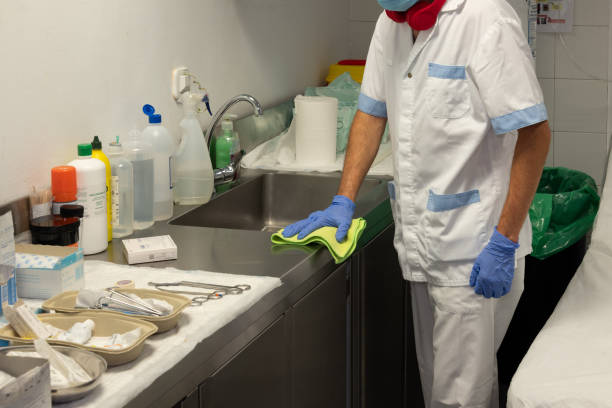
“Cleaning” and “decontamination” are not always the same task.
Cleaning generally aims to remove dirt and residues.
Decontamination aims to reduce or eliminate biological hazards to a level appropriate for the next activity.
WHO has a dedicated monograph on Decontamination and waste management, covering cleaning, disinfection, sterilization, and waste management methods within a risk-assessment framework.
For laboratory equipment, the procedure should answer:
- Which surfaces may users clean?
- Which areas may be contaminated by specimens?
- Which agents may be used?
- Which components must not allow liquid ingress?
- What condition should the device be in before cleaning?
- When should technical support be contacted?
This is particularly important before technicians open equipment for maintenance.
A device that appears clean externally may still contain hazards in internal areas that have contacted specimens or waste.
9. Do Not Overlook Waste Generated Inside Equipment
Many automated systems make waste less visible to users while the device is operating.
However, waste may still be present in:
- Containers.
- Tubing.
- Trays.
- Tips.
- Cartridges.
- Cuvettes.
- Waste containers.
- Supplies that have contacted specimens.
Operators should know:
- What types of waste are generated.
- Where the waste is collected.
- When it needs to be handled.
- What risks are involved when removing or replacing containers.
- How to respond to leaks or spills.
Waste management should not be considered only after the device displays a “waste full” alert.
Final disposal should follow the facility's waste procedures and applicable requirements.
10. Equipment Alerts Should Lead to a Clear Action
A modern laboratory may receive many types of alerts.
| Alert Category | Example Situation | What the SOP Should Clarify |
|---|---|---|
| Specimen | Specimen not recognized, insufficient sample, abnormal position | Who checks the issue and how the specimen should be handled next |
| Reagent | Insufficient, expired, or not recognized | Who is permitted to replace and confirm it |
| Equipment | Temperature, mechanical, sensor, or pressure issue | When use should stop and technical support should be contacted |
| System | Connectivity loss, software error, memory issue | How to maintain workflow and manage data |
| Waste | Full container or waste-line fault | How to handle the issue safely before continuing |
Users need to know not only how to clear an alert, but also what the alert means and under which conditions operation may continue.
A common error is:
Device displays an error → user resets it → device starts again → incident is considered resolved.
A reset may remove the visible symptom of an error without addressing the underlying cause.
For recurring faults, the laboratory should have a recording mechanism to determine when the issue has exceeded the operator's scope of action.
11. Interlocks and Protective Mechanisms Should Not Be Bypassed
Equipment may be designed with:
- Locking covers.
- Door sensors.
- Rotor sensors.
- Temperature checks.
- Pressure alerts.
- Movement limits.
- Software or hardware interlocks.
These mechanisms exist to prevent the device from operating under certain conditions.
If users regularly try to bypass them so the equipment can operate faster, this is no longer an isolated user issue but a system-level risk.
If an interlock is frequently activated inappropriately, the technical cause should be assessed.
Protective mechanisms should not be disabled simply to maintain throughput.
12. Automated Equipment Still Requires Operator Oversight
“Automated” does not mean “no checking required.”
A system may automatically perform many steps such as specimen aspiration, mixing, incubation, measurement, signal processing, and data transmission, but it may still depend on users for:
- Loading the correct supplies.
- Checking equipment status.
- Responding to alerts.
- Observing abnormalities.
- Managing waste.
- Cleaning.
- Monitoring QC according to laboratory procedures.
- Requesting support when faults exceed the operator's scope.
Automation primarily changes the type of work people need to perform; it does not remove operator responsibility.
13. Maintenance Is Part of Safe Equipment Use
From a safety perspective, maintenance should answer two different questions:
Is the equipment safe enough to continue operating?
and:
Is the equipment safe enough for a technician to open and repair?
The second question is often overlooked.
Before maintaining equipment that has come into contact with specimens, the laboratory and technical team should determine:
- Decontamination status.
- Areas where hazards remain.
- Components that have contacted specimens.
- Appropriate protective measures.
- Areas that cannot be fully decontaminated, where applicable.
A handover statement such as “the machine has been cleaned” may not be sufficient where significant biological risks are present.
14. When Should Equipment Be Temporarily Removed from Use?
Equipment should not continue operating simply because the laboratory has a high workload.
Signs requiring assessment may include:
- Abnormal vibration or noise.
- Leakage.
- Burning odor.
- Electrical faults.
- Repeated alerts.
- Temperature outside the required range.
- Protective mechanisms not functioning.
- Liquid entering an inappropriate area.
- Incidents that may affect specimens or operators.
The decision to return equipment to service should be based on the cause of the incident and the level of intervention performed, not simply on whether the device can be powered on again.
If the device has only been reset but the cause of a recurring safety-related fault has not been identified, the condition should continue to be assessed.
15. Safety When Equipment Connects to LIS or Hospital Networks
Modern laboratory equipment may exchange:
- Orders.
- Specimen IDs.
- Results.
- Equipment status.
- QC data.
- Alerts.
- Technical data.
Operational safety therefore also includes ensuring that the device is associated with the correct specimen and correct identifier.
A technically functioning connection may still create risk if:
- A barcode is read incorrectly.
- Specimen IDs are duplicated.
- Specimen sequence does not match.
- System clocks are misaligned.
- Test mapping is incorrect.
- Results are transmitted to the wrong destination.
When middleware, LIS, firmware, or equipment interfaces are changed, the impact on the entire workflow should therefore be assessed rather than checking only whether the device remains connected.
16. Operators Should Be Trained for Each Specific Device
Laboratory experience does not automatically mean that a staff member is competent to operate every device.
Training should be linked to:
equipment + workflow + specimen type + risks + limits of user responsibility.
WHO emphasizes the role of initial training, refresher training, and supervised training in building a laboratory safety culture.
An operator training program should help users understand not only “which button to press,” but also:
- Which conditions are normal.
- Which alerts they may address independently.
- When the device must be stopped.
- When technical support is required.
- How specimen incidents should be handled.
- Which areas may be contaminated.
- Which actions they are not permitted to perform.
Operator competency should be assessed based on actual work rather than simply whether the person attended a training session.
17. SOPs Should Reflect the Actual Model and Configuration in Use
A generic SOP titled “Laboratory Analyzer Operation” can easily become too broad.
Even within the same product family, different models or software versions may have different:
- Alert mechanisms.
- Door-opening procedures.
- Supply replacement procedures.
- Cleaning cycles.
- Waste locations.
- Levels of automation.
Internal documentation should therefore be version-controlled and linked to the correct model or equipment group.
When firmware or software changes, the laboratory should assess whether the SOP also needs to be updated.
18. Do Not Allow Throughput Pressure to Change Safe Operating Behavior
One of the situations most likely to create deviations is when the laboratory is overloaded.
When specimen volume rises quickly, users may be tempted to:
- Skip checks.
- Load specimens too quickly.
- Delay cleaning.
- Reset alerts.
- Continue using equipment showing abnormal signs.
- Postpone maintenance.
- Place supplies in temporary locations.
This is why safety cannot depend only on telling staff that they “must be careful.”
The facility should consider simultaneously:
equipment capacity + staffing + specimen volume + equipment downtime + backup equipment.
If the workflow regularly forces operators to choose between “following the correct procedure” and “returning results on time,” the operating system itself should be reassessed.
Safety Control Framework by Stage of Equipment Use
| Stage | Items to Control |
|---|---|
| Before operation | Environmental conditions, power supply, equipment status, supplies, waste, existing alerts |
| During specimen loading | Specimen identification, containers, leakage, aerosol risk, appropriate handling |
| During operation | Equipment status, abnormal noise/vibration, alerts, temperature, connectivity |
| During specimen/result retrieval | Exposure risk, waste, used supplies, identification |
| After operation | Cleaning, decontamination where required, waste handling, recording abnormalities |
| When an error occurs | Stop/continue according to procedure, isolate risks, record the event, request support |
| Before maintenance | Decontamination status, power supply, hazardous areas, handover to technical personnel |
| After maintenance | Required functional checks before returning the equipment to service |
Common Mistakes in Laboratory Equipment Safety
Assuming Automated Equipment Has Low Risk
Automation may reduce certain manual tasks while creating new points of risk such as specimen compartments, aspiration probes, waste systems, and troubleshooting steps.
Cleaning Only When Visible Dirt Is Present
Contamination is not always visible.
Cleaning and decontamination procedures should be based on the activity and risk rather than visual inspection alone.
Using One Disinfectant for Every Device
This may damage surfaces or components.
Compatibility with the equipment should be checked.
Resetting Alerts Repeatedly
Recurring alerts are important data about equipment condition.
Clearing an alert is not the same as correcting the fault.
Allowing Technicians to Open Equipment Without Assessing Biological Risks
This intersection between biosafety and technical servicing is often overlooked.
Training Only at Installation
Competency may need to be updated when personnel, configurations, software, or procedures change.
Changing Accessories Without Authorization
Incompatible rotors, racks, aspiration tips, cables, containers, or accessories may affect both equipment function and safety.
How to Build a Safety Checklist for Each Device
Instead of using one long checklist for the entire laboratory, the facility may develop a short control sheet for each equipment group that clarifies:
- Conditions to check before operation.
- Main risks associated with the equipment.
- PPE or containment equipment required according to the risk assessment.
- Alerts that users are permitted to address.
- Faults that require the device to be stopped.
- Cleaning or decontamination agents permitted for use.
- Procedures for specimen spills, breakage, or leakage.
- Conditions required before handing the device over to technical personnel.
- The person or department to contact when an issue exceeds the user's scope.
- Conditions for returning the equipment to service.
A checklist does not replace an SOP. Its purpose is to help operators quickly review important safety points at the appropriate time.
Frequently Asked Questions About Safety in the Use of Laboratory Equipment

Is Laboratory Equipment Safety Only About Electrical Safety?
No. Electrical safety is only one component. Risks may also arise from specimens, aerosols, moving mechanisms, chemicals, heat, waste, cleaning, environmental conditions, and user practices.
Do Automated Laboratory Analyzers Require Decontamination?
It depends on the equipment design, specimen type, and risk. Manufacturer instructions and the facility's decontamination procedures should be followed rather than applying the same method to every device.
Should Operators Handle Every Alert Themselves to Reduce Downtime?
No. The facility should define which alerts fall within the operator's scope and which require escalation to technical personnel or the supplier.
Can One Cleaning Agent Be Used for All Equipment?
This should not be assumed. Equipment materials and construction differ, so cleaning agents should be compatible with the requirements of each system.
Why Do Centrifuges Require Specific Controls?
In addition to mechanical risks from rotating components, certain situations may generate aerosols from specimens. WHO uses centrifuges as an example in risk assessment and mentions sealed rotors or safety cups as measures that may need to be considered depending on the situation.
Do Biological Safety Cabinets Require Periodic Testing?
Yes. WHO guidance on BSCs states that cabinet function and integrity should be certified at installation, after relocation, and periodically thereafter, at least annually, by competent technicians according to applicable standards and manufacturer requirements.
May Operators Open Equipment and Repair It Themselves?
They should only perform tasks within the scope permitted by the manufacturer and internal procedures. Technical repairs should be performed by personnel with appropriate competency and authorization.
Does Regular Preventive Maintenance Mean Equipment Is Always Safe?
No. Safety also depends on actual condition, use, environment, accessories, and incidents occurring between maintenance intervals.
When Should Equipment Be Taken Out of Service?
When a condition may affect safety or reliability and the operator cannot determine the cause or is not authorized to address it, the equipment should be assessed before further use.
This article is provided for informational purposes regarding the operation and safety of laboratory equipment. Specific procedures should be based on the facility's risk assessment, manufacturer instructions, equipment type, specimen type, and applicable requirements. This article does not provide instructions for performing or interpreting any specific diagnostic test.
From Technical Specifications to Safe Operation: Explore Laboratory Equipment at PHARMEDI & HEALTHCARE VIETNAM 2026
When selecting laboratory equipment, the discussion should not stop at how many specimens the system can process per hour or how automated the system is. Installation conditions, alert mechanisms, waste handling, cleaning requirements, maintenance capability, and the scope of technical support can all directly affect how the equipment is operated after installation in the laboratory.
At PHARMEDI & HEALTHCARE VIETNAM 2026, the Product Showcase Area includes categories such as medical devices and supplies, diagnostic technologies, and laboratory equipment. According to official information from the Organizing Committee, this is one of the areas where professional visitors can explore solutions, compare technologies, and identify options aligned with their organization's investment or upgrade plans.
For laboratories, hospitals, or organizations evaluating new equipment, direct exploration at PHARMEDI VIETNAM 2026 can be used to examine issues that product documentation may not fully demonstrate:
- Actual electrical and environmental requirements.
- How the system controls specimens and waste.
- Important categories of alerts.
- The scope of actions users are permitted to perform.
- Compatible cleaning or decontamination agents.
- Requirements before equipment is handed over for technical maintenance.
- Accessories and supplies requiring periodic replacement.
- How the supplier organizes training and technical support after installation.
These questions help shift equipment selection from:
“What features does the device have?”
to:
“How will those features be operated safely and maintained under the actual conditions of the laboratory?”
From Procurement Decisions to Long-Term Operating Capability
This perspective can also be expanded through the International Conference Series on Investment and Innovation in Healthcare, taking place over two days, September 22–23, 2026.
On Day 1 – September 22, the program addresses industry growth, investment trends, and specifically hospital supply procurement and investment decisions. For laboratory equipment, this perspective is relevant for considering not only purchase price and throughput, but also implementation conditions, supplies, maintenance, and post-investment support capability.
On Day 2 – September 23, the focus shifts to Hospital Management & Operations, including the hospital of the future, operations, quality, and innovation. For laboratories, these topics raise broader questions about how equipment is incorporated into a controlled operating system, from infrastructure and staffing to safety procedures and the ability to maintain operations when incidents occur.
Discuss Implementation Requirements in Greater Depth Through B2B Matchmaking
If a facility has already identified the equipment categories it needs to evaluate, B2B Matchmaking at PHARMEDI provides additional opportunities for one-to-one engagement with companies based on needs and potential fit.
Instead of discussing equipment configuration alone, hospitals and laboratories can focus on issues that directly affect operations, including installation requirements, compatible supplies, cleaning and decontamination procedures, training scope, technical response times, spare parts, replacement equipment, and supplier responsibilities when incidents occur.
This is also where operational safety connects with investment decisions: appropriate equipment should not only perform the required laboratory function but also fit the facility's space, infrastructure, staffing, safety procedures, and technical support capabilities.
Dates: September 22–24, 2026
Venue: Saigon Exhibition and Convention Center (SECC), Ho Chi Minh City
Exhibitor Registration:https://pharmed.vn/exhibitor/application-form
Visitor Registration:https://ers-vn.informa-info.com/pha2026?cid=FB
Contact:
Booth Booking: [email protected] (Thanh Thuý)
Media Support: [email protected] (Anita Pham)
Visitor Support: [email protected] (Ciel Le)
Related post
- The Drug Administration of Vietnam signed a Memorandum of Understanding to support development cooperation of the Biopharmacy industry in Vietnam
- Pharmedi 2019 - Information Science
- Kết quả đánh giá chất lượng bệnh viện thuộc Ngành Y tế TP.HCM năm 2019
- German firms optimistic about VN economy’s recovery in the medium-term