


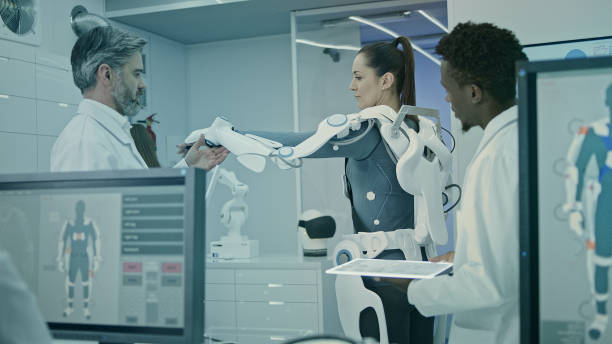
Rehabilitation robots are not limited to “automated gait training” systems. This technology category includes many different configurations, from upper-limb rehabilitation robots, hand training devices, gait training robots, lower-extremity exoskeletons, to interactive systems using sensors and visual feedback.
A common characteristic of robotic devices is the use of one or more components such as mechanical structures, motors, sensors, controllers, and software to assist, guide, or record movement according to the system design.
Robots may help standardize certain repetitive movements, record training-session data, and support rehabilitation professionals in tasks requiring a high number of repetitions. However, this technology does not replace clinical assessment, rehabilitation goals, or the role of healthcare professionals.
WHO defines rehabilitation as a set of interventions designed to optimize functioning and reduce disability in individuals with health conditions in interaction with their environment. Therefore, the value of a robot should not be assessed based on how advanced the technology appears, but on how well it fits the functional goals, users, service model, and resources of the facility.
The FDA also separately classifies certain rehabilitation devices that use robotic technology. For example, a powered lower-extremity exoskeleton is described as a device consisting of a powered external orthotic structure, controller and/or sensors that assist movement of one or more lower-extremity joints.
What Is a Rehabilitation Robot?
From a technical perspective, rehabilitation robots are devices that use mechatronic and control components to assist, guide, measure, or create interaction during rehabilitation activities.
A system may include:
- Mechanical frame.
- Motors or actuators.
- Position sensors.
- Force or torque sensors.
- Controller.
- Suspension or body-weight support system where applicable.
- User interface.
- Software.
- Display or interactive games.
- Protective mechanisms.
- Emergency stop button.
- Data-recording module.
Not every rehabilitation device with a screen, sensors, or games is a robot.
The FDA also has a separate category for interactive rehabilitation exercise devices, indicating that a system may use sensors, cameras, and visual feedback to support rehabilitation activities without necessarily being a robot that applies force to the body.
Therefore, before describing a product as a “rehabilitation robot,” the facility should understand exactly:
Is the device measuring movement, applying force, assisting movement, resisting movement, or simply providing interactive feedback?
What Types of Rehabilitation Robots Are There?

They can be classified according to the body region and how the robot interacts with the user.
| Group | Main Characteristics | Factors to Evaluate |
|---|---|---|
| Upper-limb robots | Assist movement of the shoulder, elbow, wrist, or multiple joints in coordination | Range of motion, assistance level, training position, adjustability |
| Hand/finger robots | Assist hand or finger movements | Size, fixation method, applied force, cleaning |
| Gait training robots | Support practice of gait cycles and lower-limb movements | Suspension system, speed, step length, setup time |
| Lower-extremity exoskeletons | Robotic frame positioned along the limbs to assist one or more joints | Body fit, weight, battery, standing/walking support, supervision requirements |
| End-effector robots | Act mainly at the distal part of the limb, such as the foot or hand | Trajectory, adjustability, degree of freedom of the joints |
| Sensor-based interactive systems | Track movement and provide feedback or interactive exercises | Tracking accuracy, space, software, data |
The table above is intended only to support classification. Commercial names and actual product configurations may vary considerably.
1. Upper-Limb Rehabilitation Robots
Upper-limb robots may be designed for:
- Shoulder.
- Elbow.
- Forearm.
- Wrist.
- Hand.
- Coordinated movement across multiple joints.
Two structures commonly discussed are end-effector and exoskeleton designs.
End-Effector Robots
The user interacts with the robot at a point such as a handle.
The robot may:
- Guide movement trajectories.
- Provide assistive force.
- Provide resistance when this is within the designed function.
- Measure position.
- Record force.
- Provide on-screen tasks.
One potential operational advantage is that body setup may be less complex than with certain exoskeleton systems.
However, movement at the handle does not mean the robot independently controls each shoulder, elbow, and wrist joint.
Upper-Limb Exoskeleton Robots
The robotic frame is positioned to correspond with the segments of the limb.
A system may act on:
- Shoulder joint.
- Elbow.
- Forearm.
- Wrist.
A potential advantage is that the robot may control or record movement across multiple joints.
In return, the facility needs to pay greater attention to:
- Joint-axis alignment.
- Body size.
- Time required to put on the device.
- Strap positioning.
- Pressure points.
- Setup process.
An exoskeleton should not automatically be assumed to be superior to an end-effector design. The two configurations serve different needs and workflows.
2. Hand Rehabilitation Robots
Hand training systems may use:
- Cable-driven mechanisms.
- Motors.
- Robotic gloves.
- Pneumatic mechanisms.
- Small exoskeletons.
- Movement or force sensors.
Certain devices may assist movements such as finger flexion–extension, multi-finger coordination, or grasp–release within the designed range.
This is a category in which particular attention should be paid to fit with the user's body dimensions.
Hands may differ considerably between users in terms of:
- Size.
- Finger length.
- Range of motion.
- Skin condition.
- Degree of joint stiffness.
Therefore, the purchasing question should not only be:
“How many movements can the device train?”
but also:
“How many patients at the facility can realistically use the device with its available size range and adjustability?”
3. Gait Training Robots
Gait training robots are among the most recognizable rehabilitation robotic systems.
A system may combine:
- Treadmill.
- Body-weight support system.
- Lower-limb robotic frame.
- Suspension system.
- Sensors.
- Software.
- Feedback display.
Some devices guide movement across multiple lower-extremity joints, while others act mainly on the distal part of the leg.
The technical objective is often to enable multiple controlled movement cycles while allowing the rehabilitation professional to adjust parameters supported by the device.
Cochrane reports that electromechanical- and robot-assisted gait training combined with physical therapy may improve the likelihood of independent walking after stroke in some cases, but the degree of benefit is not consistent across all patient groups, and there is insufficient basis to conclude that one type of device is the most appropriate for everyone.
Therefore, the evidence should not be interpreted as the statement:
“Gait training robots are better for every patient.”
4. Lower-Extremity Rehabilitation Exoskeletons

An exoskeleton is a powered frame positioned externally around the body.
According to the FDA, a powered lower-extremity exoskeleton consists of powered external orthotic components that use controllers and/or sensors to assist movement at one or more lower-extremity joints.
When evaluating an exoskeleton, facilities should pay attention to:
- Supported user size range.
- User height and limb-segment lengths.
- Supported user weight.
- Fixation mechanism.
- Battery.
- Charging time.
- Device weight.
- Donning/doffing time.
- Assistance requirements.
- Accompanying assistive devices.
- Emergency stop procedure.
A facility should not assume that an exoskeleton designed for one user group can be applied unchanged to another group.
The intended use and limitations should be checked in the documentation for the specific product.
5. Lower-Limb End-Effector Robots
Not every gait training robot requires a robotic frame to be worn on the legs.
In an end-effector system, the feet may be positioned on controlled platforms or footplates that generate a designed movement trajectory.
This structure may:
- Reduce some requirements for multi-joint alignment.
- Allow some freedom of movement in more proximal joints depending on the design.
- Generate repetitive movement cycles at the distal part of the limb.
However, the ability to independently control the hip, knee, and ankle may differ from that of an exoskeleton.
Therefore, these two technologies should not be compared by asking:
“Which machine is more advanced?”
They should be evaluated in relation to the clinical goals and workflow of the rehabilitation department.
Is the Effectiveness of Rehabilitation Robots the Same in Every Case?

No.
Research findings depend on:
- Condition or patient group.
- Degree of functional impairment.
- Type of robot.
- Intervention design.
- Stage of rehabilitation.
- Training intensity.
- Comparator intervention.
- Outcome measured.
A 2024 systematic review and meta-analysis of upper-limb rehabilitation robots after stroke reported some benefits for motor function while also showing that effects depended on intervention type and study characteristics.
Therefore, facilities should not select robots based on a general statement such as:
“The device helps patients recover faster.”
Instead, they should ask:
- Which patient group was studied?
- Which type of robot was used?
- What was the comparator?
- Which outcomes changed?
- How certain is the evidence?
- Are the study conditions similar to the facility's service model?
Practical Limitations of Rehabilitation Robots
Not Every Patient Can Use the Same System
Limitations may relate to body size, range of motion, ability to maintain posture, joint configuration, or the intended use of the device.
Specific criteria should be taken from the documentation for each product rather than creating one universal contraindication list for all rehabilitation robots.
Setup May Take Time
A complex robot may require:
- Length adjustment.
- Joint alignment.
- Strap attachment.
- Positioning the patient.
- Selecting the user profile.
- Checking the operating range.
If a session lasts 45 minutes but also requires substantial additional time for setup, device removal, and cleaning, actual capacity will differ significantly from calculations based only on the time the robot is operating.
The Device May Require Significant Space
A gait training robot may require:
- A dedicated area.
- Access pathways.
- Working space around the device.
- Wheelchair space.
- Space for supporting staff.
- Accessory storage.
Costs Extend Beyond the Purchase Price
Facilities should also account for:
- Accessories.
- Straps.
- Wear components.
- Batteries.
- Software.
- Licenses.
- Maintenance.
- Training.
- Upgrades.
- Computers.
- Network infrastructure.
- Equipment downtime.
Technology May Change Quickly
Over the device lifecycle:
- Software may change.
- Operating systems may reach end of support.
- Manufacturers may replace modules.
- Certain accessories may be discontinued.
Long-term support capability should therefore be included among procurement criteria.
How Much Space Should Be Prepared for a Rehabilitation Robot?

There is no single standard area requirement that applies to every robot.
The facility should use the actual product dimensions and map the intended workflow.
Equipment Dimensions
Do not measure only the footprint when the device is stationary.
Also account for:
- Doors or moving components.
- Movement zone.
- Operator area.
- Wheelchair maneuvering area.
- Access area for incident handling.
- Maintenance clearance.
Transport Route
Large robots may need to pass through:
- Doors.
- Corridors.
- Elevators.
- Ramps where applicable.
The shipping dimensions should be checked, not only the dimensions after installation.
Floor Load and Surface
Some systems include a large frame, treadmill, and the user.
Specific load requirements should be confirmed by the supplier so that the facility infrastructure team can assess suitability.
Power Supply
Facilities should confirm:
- Voltage.
- Power requirements.
- Grounding.
- Backup power requirements where applicable.
- Outlet locations.
- Battery and charging system.
Network
Some systems require network connectivity for:
- Data synchronization.
- Updates.
- Remote support.
- User management.
The facility should ask clearly which functions of the device remain available if the network or Internet connection is interrupted.
What Safety Features Should Be Evaluated?
Robots generate force and movement directly on or near the body, making safety design an important evaluation criterion.
The FDA currently lists IEC 80601-2-78:2019 among its recognized consensus standards for powered lower-extremity exoskeletons. This standard addresses basic safety and essential performance requirements for medical robots used for rehabilitation, assessment, compensation, or alleviation. This does not mean the standard automatically becomes a mandatory legal requirement for every rehabilitation robot in Vietnam, but it illustrates that this equipment category has specialized technical safety considerations.
When evaluating a product, facilities may consider:
- Emergency stop button.
- Movement limits.
- Force/torque control mechanisms according to the design.
- Detection of abnormal conditions.
- Device behavior during power loss.
- User-release mechanism.
- Mechanical pinch or crush points.
- Straps.
- Fall-prevention support systems where applicable.
- Alerts.
- Pre-use checks.
An important question is:
If an incident occurs, what should staff do to remove the user from the robot according to the manufacturer's instructions?
This procedure should be included in training before the device enters routine use.
What Should Be Considered for Straps, Pressure Points, and Contact Accessories?
A robot may contact the body through:
- Straps.
- Cuffs.
- Harnesses.
- Pads.
- Handles.
- Gloves.
- Foot interfaces.
- Orthoses.
These components should be evaluated for:
- Size.
- Adjustability.
- Comfort.
- Location of applied force.
- Cleaning.
- Service life.
- Replacement availability.
If a specialized accessory fails but requires several weeks to import, the entire robot may become unavailable even though the electromechanical components remain functional.
Accessories are therefore not secondary items when evaluating equipment maintainability.
Cleaning and Infection Control
A rehabilitation robot may be used by multiple people during the same day.
Surfaces requiring attention may include:
- Handles.
- Straps.
- Cuffs.
- Harnesses.
- Seats.
- Armrests.
- Touchscreens.
- Foot-contact components.
- Wearable accessories.
The facility should clarify:
- Which surfaces need to be cleaned between users?
- Which cleaning agents are compatible?
- Can straps be removed and washed?
- How long do accessories require to dry?
- Are replacement accessories available for rotation?
- Are sensors compatible with the cleaning agents being used?
Strong chemicals should not be used arbitrarily simply to shorten cleaning time.
Manufacturer instructions should be incorporated into the facility's SOPs.
How Does Maintaining a Robot Differ from Maintaining Conventional Mechanical Exercise Equipment?
A robot may contain many components:
- Motors.
- Gearboxes.
- Belts.
- Bearings.
- Sensors.
- Encoders.
- Controllers.
- Batteries.
- Computers.
- Displays.
- Software.
- Lifting mechanisms.
- Harnesses.
A minor sensor fault may cause the system to stop operating because of its safety mechanisms.
Therefore, before purchasing, facilities should ask:
- What is the preventive maintenance schedule?
- Which items can users inspect themselves?
- Which items require an engineer?
- Are specialized technical checks or adjustments required?
- Does the supplier have local engineers?
- Where are spare parts stocked?
- What is the lead time for components?
- Is remote diagnostics support available?
- Is there an alternative solution if the device remains unavailable for an extended period?
Robot Software and Data Should Be Evaluated as Part of the Device
Modern robots often include software for:
- Account management.
- Session setup.
- History storage.
- Parameter monitoring.
- Data visualization.
- Report export.
When purchasing equipment, facilities should ask:
- Where are data stored?
- Is the computer included in the configuration?
- Is there a limit on the number of users?
- Are recurring license fees required?
- Is cloud connectivity required?
- Which functions are affected if the license is not renewed?
- Can data be exported?
- What export formats are available?
- Is an API available?
- Can the system connect with HIS/EMR?
- Does it provide an audit trail appropriate to the facility's needs?
- Will data be lost if the computer is replaced?
A system may have an attractive dashboard, but if the data are locked within proprietary software, long-term usability may be limited.
Should Cybersecurity Be Considered for Rehabilitation Robots?
Yes, if the robot uses:
- Computer operating systems.
- Wi-Fi.
- Ethernet.
- Cloud services.
- Remote access.
- USB.
- User accounts.
- Third-party software.
Facilities should ask:
- How long will the operating system be supported?
- Who is authorized to perform updates?
- How does the supplier access the system remotely?
- How are service accounts managed?
- Can the robot be placed within an appropriate network segment?
- How does the supplier provide updates when a vulnerability is identified?
A rehabilitation robot is a rehabilitation device, but it may also become an endpoint on the hospital network.
10 Criteria for Selecting Rehabilitation Robots

1. Fit with the Functional Goal
First, the facility should determine whether it intends to invest in technology for:
- Upper limb.
- Hand.
- Standing.
- Gait.
- Lower limb.
- Another specialized movement goal.
The facility should not purchase a robot first and then search for a suitable patient group afterward.
2. Fit with the Patient Population
Review:
- Size range.
- Adjustability.
- Intended use.
- Device limitations.
- Patient groups commonly served by the facility.
3. Adjustment Range and Customization
Factors that may be reviewed include:
- Limb length.
- Joint position.
- Height.
- Assistive force.
- Speed.
- Level of assistance.
- Exercise configuration.
Only functions that are actually within the product's intended design should be evaluated.
4. Setup Time
Measure the complete process:
patient arrival → setup → use → removal → cleaning → ready for the next session.
This is an important operational indicator that often does not appear in marketing specifications.
5. Safety
Evaluate:
- Emergency stop.
- Interlocks.
- Movement/force limits.
- Fall-prevention mechanisms where applicable.
- Emergency release mechanisms.
- Alerts.
- Mechanical pinch points.
6. Space and Infrastructure
Review:
- Space requirements.
- Power.
- Network.
- Charging.
- Floor load.
- Transport route.
- Accessory storage.
- Maintenance space.
7. Workforce Capability
Determine:
- How many people operate the device?
- How many people are required for setup?
- How long does training take?
- Is internal competency assessment required?
- How are new staff trained?
8. Data and Software
Determine:
- Which data are stored.
- Whether data can be exported.
- Whether software fees apply.
- Whether multiple users can be managed.
- Whether the system can connect to other platforms.
9. Technical Service
Evaluate:
- SLA.
- Engineers.
- Spare parts.
- Remote support.
- Maintenance.
- Expected downtime.
10. Total Lifecycle Cost
Do not calculate only the purchase price of the robot.
Also include:
- Accessories.
- Software.
- Maintenance.
- Batteries.
- Straps.
- Supplies.
- Training.
- Upgrades.
- Components.
- Infrastructure.
- Costs associated with equipment downtime.
Comparison of Selected Rehabilitation Robot Configurations
| Factor | End-Effector Robot | Fixed Exoskeleton Robot | Wearable Exoskeleton |
|---|---|---|---|
| Interaction point | Mainly at the distal part of the limb | Frame aligned with multiple joints | Frame worn on the body |
| Setup | May be simpler depending on the device | May require alignment across multiple joints | Requires donning, adjustment, and fit checks |
| Mobility | Usually fixed | Usually fixed | May allow movement within the designed range |
| Space | Depends on the device | May be relatively large | Requires an appropriate walking area |
| Battery | Not required by every system | Depends on the design | Usually an important factor |
| Data | Depends on the platform | Depends on the platform | Depends on the platform |
| Maintenance | Electromechanical system | May be more complex depending on the configuration | Electromechanical system + battery + wearable components |
This table should not be used to conclude that one type is better than another. Each design should be assessed based on the specific product and intended use.
Roadmap for Implementing Robots in a Rehabilitation Facility

Step 1: Define the Need
Collect information on:
- Number of patients.
- Functional groups.
- Upper-limb/lower-limb needs.
- Current capacity.
- Bottlenecks.
- Staffing.
Step 2: Define the Intended Workflow
Clarify:
- At which step will the robot be used?
- Who brings the patient to the device?
- Who performs setup?
- Who supervises the session?
- Who cleans the device?
- Who manages the data?
Step 3: Assess Infrastructure
Check:
- Room.
- Power.
- Network.
- Floor.
- Doors.
- Storage.
- Waiting area.
- Wheelchair accessibility.
Step 4: Demonstrate Using Real-World Scenarios
Do not rely only on a product presentation.
Simulate:
- Setup.
- Adjustment.
- User transfer.
- Emergency stop.
- Report export.
- Cleaning.
Step 5: Assess Technical Resources
Clarify:
- Maintenance.
- SLA.
- Training.
- Components.
- Software.
- Warranty.
Step 6: Pilot and Measure Operational Data
Possible indicators include:
- Setup time.
- Sessions per day.
- Cancellation rate due to equipment issues.
- Downtime.
- Cleaning time.
- Utilization.
- Staff feedback.
Step 7: Evaluate Before Expansion
If the robot is used less frequently than expected, determine whether the reason relates to the patient population, setup time, staff capability, scheduling, or downtime.
Low utilization should not be addressed by purchasing additional equipment before the underlying cause is understood.
Frequently Asked Questions About Rehabilitation Robots

What Types of Rehabilitation Robots Are Available?
There are many categories, including upper-limb robots, hand robots, gait training robots, lower-extremity exoskeletons, and sensor-based interactive systems. Structures may use end-effector, exoskeleton, or other designs.
Can a Gait Training Robot Replace a Physical Therapist?
No. A robot is a supporting tool. Rehabilitation professionals still need to assess the patient, select goals, configure the device, supervise use, make adjustments, and manage situations that arise.
Are Exoskeletons and Fixed Gait Training Robots the Same?
Not entirely. An exoskeleton is a robotic frame aligned with and attached to the body, while some fixed gait training robots use treadmills, suspension systems, or end-effectors. Their capabilities and workflows vary according to the design.
Is a Rehabilitation Robot Better If It Has More Degrees of Freedom?
Not necessarily. The number of degrees of freedom is only one technical parameter. The device should fit the intended goal, required adjustability, and the facility's operational capabilities.
Do Rehabilitation Robots Use AI?
Some systems may use AI or adaptive algorithms, but not every robot includes AI. Facilities should ask the supplier which functions actually use AI and what role the AI performs.
Can Robot Data Be Used to Assess Progress?
Data such as repetitions, force, trajectory, or assistance level may support monitoring of activity performed on the device. However, these data should not automatically be treated as validated clinical outcomes.
Should a Small Facility Invest in a Rehabilitation Robot?
The decision cannot be based on facility size alone. Factors include the number of suitable patients, expected utilization, staffing, space, maintenance capability, and total lifecycle cost.
When Selecting a Robot, Should Price or Technology Be Prioritized?
The decision should not be based solely on either factor. More important is the fit with the patient population, workflow, staffing, infrastructure, and the facility's ability to maintain the equipment over the long term.
This article is provided for informational purposes regarding rehabilitation technologies and equipment selection. Patient selection, rehabilitation goals, training modes, and robot operating parameters should be determined by qualified professionals according to the device's intended use, manufacturer instructions, and applicable requirements. This article does not provide rehabilitation protocols or individualized treatment guidance.
Explore Advanced Rehabilitation Technologies at RAVEX within PHARMEDI & HEALTHCARE VIETNAM 2026
Rehabilitation robots create value only when the technology fits the facility's movement goals, patient population, space, staffing, and actual operational capabilities. Therefore, for hospitals or centers considering gait training robots, upper-limb support systems, exoskeletons, or other mobility-support solutions, direct exposure to rehabilitation technologies can help clarify many factors that individual technical specifications may not fully demonstrate.
At PHARMEDI & HEALTHCARE VIETNAM 2026, the rehabilitation sector is expanded through RAVEX – the International Exhibition on Rehabilitation Equipment, Technology, and Solutions for People with Disabilities, held concurrently with PHARMEDI. This is the official name and specialized scope announced by the Organizing Committee.
For facilities evaluating rehabilitation robots or mobility-support technologies, exploration at PHARMEDI VIETNAM 2026 can focus on:
- Is the technology intended for the upper limb, hand, standing and walking, or another functional category?
- Does the design use an exoskeleton, end-effector, interactive sensors, or another support mechanism?
- Does the adjustment range fit the facility's patient population?
- How long does a complete session take from setup → use → device removal → cleaning → readiness for the next user?
- How many staff members are required to operate and supervise the system?
- Which data does the device record, and can those data be exported from the software?
- What space, power, network, and maintenance-area requirements does the device have?
- How are accessories, batteries, and wear components supplied?
- What are the maintenance schedule, SLA, and spare-part lead times?
- If the device becomes unavailable, what support options does the supplier provide?
RAVEX provides an appropriate setting for facilities to explore and compare rehabilitation technologies, assistive devices, and support solutions presented at the event, rather than evaluating technology only through product documentation or demonstration videos. PHARMEDI also identifies rehabilitation as one of the specialized sectors expanded within the 2026 exhibition ecosystem.
Importantly, facilities should not assume that a specific robot or exoskeleton model will definitely be exhibited at RAVEX unless it has been announced by the Organizing Committee or included in the published product list. For organizations interested in this technology category, RAVEX still provides a relevant opportunity to explore the rehabilitation ecosystem, identify suppliers, and compare investment needs with solutions actually presented at the exhibition.
Rehabilitation Technology Should Be Considered Within the Broader Context of Hospital Investment and Operations
Selecting a rehabilitation system involves more than the device's ability to support movement. The International Conference Series on Investment and Innovation in Healthcare, taking place on September 22–23, 2026, provides an additional management perspective.
During Day 1 – September 22, discussions on industry growth, investment, and hospital supply procurement and investment decisions can help facilities evaluate rehabilitation robots from a broader perspective: not only the initial purchase price, but also expected utilization, staffing requirements, accessories, software, maintenance, and total lifecycle cost.
On Day 2 – September 23, the program shifts to Hospital Management & Operations, including perspectives on the hospital of the future, quality, innovation, and development strategies. For advanced rehabilitation equipment, this is an important continuation because investment effectiveness also depends on whether the device can be integrated into routine workflows, utilized sufficiently, and maintained reliably over the long term.
From RAVEX to the conference series, facilities can therefore evaluate rehabilitation technology through two questions:
“Is the device appropriate for the patient population and rehabilitation goals?”
and
“Does the facility have the capability to operate the device effectively for many years?”
B2B Matchmaking – Exploring the Fit of Individual Solutions in Greater Depth
Once the relevant technology category has been identified, B2B Matchmaking at PHARMEDI provides additional opportunities for one-to-one connections between professional visitors and companies based on their needs and level of fit.
For hospitals or rehabilitation centers, discussions can go deeper into issues that are difficult to assess from brochures alone, such as supported user ranges, actual setup time, required staffing, demonstration options, infrastructure requirements, data and software, replacement accessories, training plans, SLAs, and post-implementation technical support capabilities.
In this way, PHARMEDI & HEALTHCARE VIETNAM 2026 gives rehabilitation organizations an opportunity to explore technology within the context of real-world operations and identify solutions that may integrate more effectively with the facility's service model, workforce, infrastructure, and long-term investment plans.
Dates: September 22–24, 2026
Venue: Saigon Exhibition and Convention Center (SECC), Ho Chi Minh City
Exhibitor Registration:https://pharmed.vn/exhibitor/application-form
Visitor Registration:https://ers-vn.informa-info.com/pha2026?cid=FB
Contact
Booth Booking: [email protected] (Thanh Thuý)
Media Support: [email protected] (Anita Pham)
Visitor Support: [email protected] (Ciel Le)
```
Related post
- Comprehensive Guide to Medical Device Classification Standards in Vietnam
- Vinamilk, Hậu Giang Pharmaceutical join hands for RD
- Triển lãm Y tế Quốc tế lần thứ 14 tại Việt Nam- Diễn đàn giao thương các doanh nghiệp Đức
- Pharmed & Healthcare Vietnam (Pharmedi 2019): Pharmaceutical companies come to Pharmedi 2019 seeking to open markets
- Vietnam's Aging Population and the Shift Toward Healthy Aging