


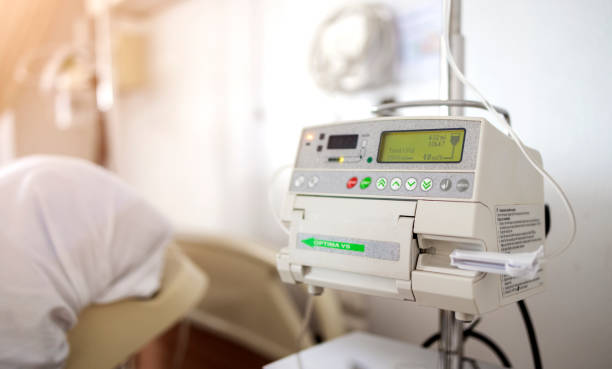
Automated infusion pumps are used to deliver fluids into a patient’s body at controlled rates and volumes. In hospitals, these devices may be used in intensive care units, emergency departments, operating rooms, inpatient wards, and other areas depending on the intended use of each model.
Unlike a syringe pump, a volumetric infusion pump typically works with a fluid bag or bottle together with an administration set, rather than using a syringe as the fluid reservoir. The pump mechanism acts on the tubing or a dedicated component to control flow according to programmed settings.
Therefore, infusion pump selection should not be based only on the infusion-rate range or screen size. Facilities should also evaluate compatible administration sets, accuracy, air-in-line detection, free-flow prevention mechanisms, occlusion detection, tubing-loading workflow, alarm systems, battery performance, software, connectivity, and the cost of consumables throughout the equipment lifecycle.
The FDA describes an infusion pump as a device that delivers fluids into the body in controlled amounts; in some peristaltic designs, rollers sequentially compress flexible tubing to move fluid forward.
IEC 60601-2-24:2012 applies to infusion pumps and volumetric infusion controllers and also includes administration sets within its scope where their characteristics affect the basic safety or essential performance of the equipment.
This reinforces an important principle:
The infusion pump and administration set should be evaluated as one system.
What Is an Automated Infusion Pump?

Within the scope of this article, automated infusion pump primarily refers to a volumetric infusion pump or large-volume infusion pump that uses electrical power and software to control delivery of fluid from a container through an administration set.
A system may include:
- Infusion pump.
- Fluid bag or bottle.
- Administration set.
- Drive mechanism.
- Sensors.
- Display and software.
- Alarm system.
- Battery.
- Pole mount or docking system.
- Network-connectivity components where supported.
Some systems may also connect with:
- Drug libraries.
- Centralized management servers.
- Data-analytics software.
- HIS/EMR through appropriate integration components.
An important point is that facilities should not purchase the pump first and assume that any administration set with a similar appearance can be used.
How Is an Infusion Pump Different from a Syringe Pump?
| Factor | Volumetric Infusion Pump | Syringe Pump |
|---|---|---|
| Fluid reservoir | Usually a bag, bottle, or larger fluid container | Syringe |
| Component acted on by the drive mechanism | Administration set/cassette depending on the design | Syringe plunger |
| Consumables with major impact | Administration set | Syringe, extension line |
| Key technical considerations | Air-in-line, free-flow, tubing loading, accuracy with the administration set | Syringe compatibility, low flow rates, startup behavior, occlusion-detection time |
| Suitability for larger volumes | Generally more suitable | Limited by syringe capacity |
| Smart-system functionality | May be supported depending on the model | May be supported depending on the model |
Thus, both devices belong to the infusion pump category but have different technical priorities.
Syringe pumps focus more heavily on:
syringe → low infusion rates → startup delay → occlusion
while volumetric infusion pumps require greater attention to:
administration set → tubing loading → air-in-line → free-flow prevention → volume control → alarms and system management.
1. How Does a Volumetric Infusion Pump Work?
The specific operating principle depends on the manufacturer and model.
A common design uses a peristaltic mechanism, in which driving components sequentially compress a section of flexible tubing to move fluid in the intended direction.
Other designs may use:
- Linear peristaltic mechanisms.
- Rotary peristaltic mechanisms.
- Dedicated cassettes.
- Proprietary structures specific to individual manufacturers.
The common principle is that the pump controls fluid delivery through the administration set or another compatible component.
Performance therefore depends not only on the motor but also on:
- Tubing diameter.
- Elasticity.
- Material.
- Geometry of the tubing segment positioned within the pump mechanism.
- Cassette, where applicable.
- Tubing-loading method.
- Condition of the administration set during use.
2. The Administration Set Is Part of the System
One common mistake when evaluating an infusion pump is treating the administration set as an ordinary consumable.
IEC 60601-2-24:2012 makes clear that administration sets fall within the scope of the standard where their characteristics affect the basic safety or essential performance of the infusion pump.
Therefore, it should not be assumed that:
“If the tubing fits, it can be used.”
The facility should confirm:
- Administration-set code.
- Manufacturer.
- Set type.
- Cassette where applicable.
- Clamp/valve.
- Filter.
- Related accessories.
- Storage conditions.
- Expiration period.
- Long-term supply availability.
What Is the Impact of Proprietary Administration Sets?
Some pumps operate only with:
- Proprietary administration sets.
- A group of validated sets.
- Dedicated cassettes.
This may help standardize the system but can also increase dependence on the consumable supply chain.
Hospitals should ask:
- How many compatible administration-set codes are available?
- Are the sets reliably supplied in Vietnam?
- Are there multiple sources or only one?
- What is the price per set?
- What is the lead time?
- If one set code is out of stock, is there a validated alternative?
A pump with a low initial purchase price but expensive or difficult-to-source administration sets may result in a higher total lifecycle cost.
3. How Important Is Correct Administration-Set Loading?

Depending on the design, the administration set may need to be positioned accurately through:
- Guide channels.
- Drive mechanism.
- Sensors.
- Clamp.
- Pump door.
If the tubing is:
- Misaligned.
- Not positioned correctly in the guide channel.
- Too loose or improperly tensioned.
- Not routed correctly through the sensor position.
- Pinched when the door is closed.
infusion performance may be affected.
The FDA has identified real-world issues involving the Baxter Novum IQ Large Volume Pump in which incorrect tubing placement in the pumping channel could be associated with over-infusion or under-infusion. Corrective instructions emphasized proper tubing placement and appropriate handling of the roller clamp.
This example does not mean that every infusion pump uses the same tubing-loading procedure.
The key lesson is:
The ability to load the administration set correctly, quickly, and consistently should be evaluated through hands-on use.
What Should Be Tested During a Demonstration?
Prospective users may be asked to directly:
- Open the pump door.
- Load the tubing.
- Route the tubing through the required positions.
- Close the door.
- Check the clamp.
- Remove the tubing.
- Reload it.
- Handle incorrect loading where the device provides detection functionality.
The evaluation should not consist only of watching a sales representative load the device once under ideal demonstration conditions.
4. Infusion Flow Accuracy
Brochures commonly state:
- Infusion-rate range.
- Accuracy.
- Volume to be infused.
- Operating modes.
However, a single accuracy figure should not be interpreted in isolation.
Facilities should ask:
- Which administration set was used for testing?
- At which infusion rates?
- Over what duration?
- Under what environmental conditions?
- How does downstream pressure affect performance?
- Does container height affect performance?
- Does the manufacturer provide data on performance changes over the period of administration-set use?
It should not be concluded that:
“Pump A is more accurate than Pump B under all conditions”
based only on one brochure specification.
5. Air-in-Line Detection
Air-in-line is an important consideration when evaluating an infusion pump.
Many systems use sensors to detect the presence of air in the tubing segment passing through the detection area.
During evaluation, facilities should clarify:
- Where is the sensor located?
- How must the administration set pass through the sensor?
- How does the device respond when air is detected?
- How is the alarm presented?
- Which sensor configurations are available?
- What action is required from the user after the alarm?
A single fixed air-volume threshold should not be created and applied to every device; limits should be based on the specific device and the facility's procedures.
6. Free-Flow
Free-flow refers to a condition in which fluid may flow beyond the level of control intended by the pumping mechanism.
This risk should be considered when:
- The pump door is opened.
- The administration set is removed.
- The clamp has not been closed correctly.
- The free-flow prevention mechanism does not operate as intended.
- The administration set is incorrectly positioned.
Some systems use:
- Clamps.
- Clips.
- Cassettes.
- Door interlock mechanisms.
- Other free-flow prevention designs.
During evaluation, facilities should ask:
- Is the free-flow prevention mechanism located on the pump or the administration set?
- What happens when the door is opened?
- What happens when the tubing is removed?
- Is an interlock mechanism used?
- At which step must the user close the clamp?
The FDA has also emphasized proper roller-clamp handling in correction instructions for the Novum IQ LVP to help reduce free-flow risk during administration-set removal and loading.
Therefore, facilities should not ask only:
“Does the pump have free-flow prevention?”
They should also demonstrate the device behavior when opening the door, removing the administration set, and reloading it.
7. Occlusion and Alarm Systems
Infusion pumps also need to detect certain forms of infusion-line occlusion.
Depending on the model, the system may monitor:
- Downstream occlusion.
- Certain upstream conditions.
- Increased pressure.
- Certain flow abnormalities.
Facilities should clarify:
- Which types of occlusion can the device detect?
- Where are the sensors located?
- Which pressure levels are available?
- How does detection time vary with infusion rate?
- How are alarms presented?
- What is the workflow for resuming infusion after the occlusion has been addressed?
8. Smart Infusion Pumps and Drug Libraries

Some infusion pumps fall into the smart pump category.
The system may support:
- Drug library.
- Department-specific configurations.
- Predefined limits.
- Event logs.
- Centralized configuration management.
- Data analytics.
- Network connectivity.
However:
Having a smart pump does not mean every potential error is eliminated.
Actual value also depends on:
- How the drug library is developed.
- Approval mechanisms.
- Updating procedures.
- Department-specific configuration.
- User training.
- User compliance.
- Change management.
This article does not recommend specific drug libraries, dose limits, or infusion parameters.
9. Centralized Management and HIS/EMR Integration
When a hospital operates many infusion pumps, managing each device independently may become complex.
Some systems may support:
- Drug-library management.
- Configuration distribution.
- Device-status monitoring.
- Event collection.
- Data analytics.
- Integration with hospital information systems.
However:
Having Wi-Fi does not mean the pump can automatically integrate with HIS/EMR.
Additional components may be required:
- Server.
- Gateway.
- Middleware.
- Interface.
- Software license.
- Data-mapping configuration.
Hospitals should ask:
- How does the device connect?
- If the network is unavailable, does the bedside pump continue operating?
- If the server stops, which functions are affected?
- How is the drug library updated?
- Can updates be distributed centrally, or must each device be updated individually?
- Which data are collected?
- Which vendors need to participate in HIS/EMR integration?
Each new connectivity function also creates additional requirements for:
- Network infrastructure.
- Cybersecurity.
- Servers.
- User accounts.
- Backup.
- Updates.
- Technical support.
Connectivity therefore should not be purchased simply because the equipment “has the feature”; there should be a clearly defined operational benefit.
10. Battery, Bedside Configuration, and Accessories
Infusion pumps may be installed:
- On a pole.
- On a trolley.
- In a rack.
- Within a docking system.
- In modular configurations depending on the manufacturer.
Battery
Facilities should review:
- Battery runtime.
- Conditions under which the runtime is specified.
- Charging time.
- Service life.
- Replacement capability.
- Battery price.
- Battery-status indication.
Battery performance is particularly important during:
- Patient transport.
- Transfers between departments.
- Power interruptions.
11. Cleaning, Maintenance, and Technical Service

Cleaning
Manufacturer instructions should be followed for:
- Cleaning agents.
- Disinfectants.
- Areas where liquid must not enter.
- Cleaning of the door and tubing-loading mechanism.
- Cleaning of sensors.
It should not be assumed that the same chemical can be used on every device.
Maintenance
Depending on the model, the program may involve:
- Visual inspection.
- Functional checks.
- Flow-rate/volume verification.
- Air-sensor checks.
- Occlusion checks.
- Alarm checks.
- Door/clamp inspection.
- Battery checks.
- Electrical safety testing according to the facility's program.
- Firmware/software updates.
- Calibration or verification where required.
The maintenance schedule should be based on manufacturer instructions and the hospital's equipment-management program rather than applying the same fixed interval to every model.
Technical Service
Before purchasing large quantities, hospitals should ask:
- Are engineers trained for the exact model available in Vietnam?
- Is suitable test equipment available?
- Where are spare parts stored?
- What are the lead times?
- Are batteries and sensors readily available?
- Is temporary replacement equipment available during repairs?
- How long does one maintenance cycle take?
12. Cybersecurity for Network-Connected Infusion Pumps
If a pump operates independently, its cybersecurity scope will differ from that of a system using:
- Wi-Fi.
- Servers.
- Centralized drug libraries.
- Data analytics.
- Remote support.
- HIS/EMR integration.
For connected devices, facilities should clarify:
- Authentication mechanisms.
- Wi-Fi security.
- Firmware lifecycle.
- Update process.
- Vulnerability management.
- Remote access.
- System logs.
- Network segmentation.
- Server lifecycle.
The question should not only be:
“Does the pump have network connectivity?”
but rather:
“What function does that connectivity support, what data are exchanged, and who is responsible for governance?”
13. Ten Criteria for Selecting an Infusion Pump
1. Intended Use and Deployment Area
Determine where the equipment is expected to be used and which users or patient populations are appropriate according to the manufacturer's intended use.
2. Compatible Administration Sets
Review:
- Administration-set codes.
- Type.
- Manufacturer.
- Supply availability.
- Cost.
- Accessories.
3. Infusion Performance
Evaluate:
- Infusion-rate range.
- Accuracy.
- Test conditions.
- Effect of administration sets and operating conditions.
4. Air-in-Line Detection
Clarify:
- Sensor mechanism.
- Tubing placement.
- Alarm behavior.
- Device response when air is detected.
5. Free-Flow Prevention
Review:
- Clamp.
- Interlock mechanism.
- Behavior when the door is opened.
- Behavior when the administration set is removed.
6. Occlusion and Alarms
Evaluate:
- Types of occlusion that can be detected.
- Pressure levels.
- Alarm time.
- Usability during troubleshooting.
7. Usability
Review:
- Tubing-loading process.
- Display.
- Programming steps.
- Unit presentation.
- Mechanisms designed to reduce incorrect operation.
8. Software and Connectivity
Clarify:
- Smart pump functionality.
- Drug library.
- Centralized management.
- Wi-Fi.
- Server.
- HIS/EMR.
- Gateway/middleware/interface.
9. Maintenance and Technical Support
Review:
- Warranty.
- SLA.
- Engineers.
- Batteries.
- Sensors.
- Spare parts.
- Temporary replacement equipment.
10. Total Lifecycle Cost
Include:
- Pump.
- Administration sets.
- Batteries.
- Mounting/docking systems.
- Software.
- Licenses.
- Servers.
- Integration.
- Maintenance.
- Spare parts.
How Do Standalone Pumps Differ from Centrally Managed Systems?
| Factor | Standalone Pump | Centrally Managed System |
|---|---|---|
| Bedside infusion | Yes | Yes |
| Server | May not be required | May be required |
| Drug library | Depends on the model | May be centrally managed |
| Configuration updates | May be performed on individual pumps | May be distributed centrally |
| Data collection | May be limited | May be more centralized |
| HIS/EMR | May not be supported | May be integrated but often requires an interface |
| Network infrastructure | Simpler | Additional network and security requirements |
| Cost | Primarily equipment and consumables | May also include servers, software, licenses, and integration |
The table is intended as general guidance; the actual scope should be confirmed for each system.
12 Questions to Ask Suppliers Before Shortlisting
1. Which administration-set codes does the pump use?
2. Are the administration sets proprietary, and are they reliably supplied in Vietnam?
3. Under what conditions was the accuracy data evaluated?
4. How does the air-in-line detection mechanism operate?
5. How does the device prevent free-flow when the door is opened or the administration set is removed?
6. How does the pump detect occlusion and generate alarms?
7. What steps are required to load the administration set, and does the device help detect incorrect loading?
8. Are the drug library and centralized management optional features that require additional purchase?
9. Which servers, gateways, middleware, or interfaces are required for HIS/EMR integration?
10. Are the battery, mounting system, and docking components included in the quoted configuration?
11. What SLA, spare-parts availability, and technical support capability are available in Vietnam?
12. What is the total multi-year cost including the pump, administration sets, software, integration, and maintenance?
Short Checklist Before Purchasing an Infusion Pump
Device
- Model and intended use are clearly defined.
- Accuracy data are available.
- Air-in-line detection has been evaluated.
- Free-flow prevention mechanism is clear.
- Occlusion alarms are clear.
- Tubing-loading workflow has been demonstrated.
Administration Sets and Operations
- Compatible administration-set codes have been confirmed.
- Supply source and lead times are clear.
- Consumable costs have been included.
- Battery and mounting systems are appropriate.
- Backup equipment arrangements are available where required.
System and Service
- Drug library/centralized management where required.
- Server and network requirements are clear.
- Integration responsibilities are defined.
- Cybersecurity has been assessed.
- Warranty, SLA, spare parts, and maintenance arrangements are clear.
Frequently Asked Questions About Automated Infusion Pumps

How Does an Automated Infusion Pump Work?
The device uses a drive mechanism that acts on the administration set or another dedicated component to control fluid flow according to programmed parameters.
Are an Infusion Pump and a Syringe Pump the Same?
No. A syringe pump uses a syringe and moves the plunger, while a volumetric infusion pump generally uses a bag or bottle together with an administration set.
Can Any Administration Set Be Used with the Pump?
This should not be assumed. The administration set should be confirmed by the manufacturer as compatible with the specific pump model.
What Is Air-in-Line?
Air-in-line refers to the presence of air within the infusion line. Many infusion pumps include sensors and alarms designed to detect this condition.
What Is Free-Flow?
Free-flow is a condition in which fluid may flow beyond the level of control intended by the pump. Clamps and free-flow prevention mechanisms should therefore be checked when loading or removing the administration set.
Can an Infusion Pump Integrate with HIS/EMR?
Some systems may support integration, but appropriate servers, gateways, middleware, or interfaces are often required. Wi-Fi connectivity alone does not mean automatic HIS/EMR integration.
Should an Infusion Pump Be Selected Based on Device Price Alone?
No. Facilities should also account for administration sets, batteries, accessories, software, licenses, servers, integration, maintenance, and long-term supply availability.
This article is provided for informational purposes regarding the principles, features, and selection of infusion pumps. Infusion rates, volumes, fluid types, medications, doses, alarm limits, and patient-specific settings should be determined by qualified professionals according to clinical orders, manufacturer instructions, and facility procedures. This article does not provide instructions for self-programming or treatment.
Evaluate Infusion Pumps Across the Device, Administration Set, and Operating System at PHARMEDI & HEALTHCARE VIETNAM 2026
For infusion pumps, comparison is incomplete if a facility looks only at infusion rate or purchase price. Compatible administration sets, air sensors, free-flow prevention mechanisms, alarms, batteries, software, and multi-device management capabilities may all influence long-term operations.
At PHARMEDI & HEALTHCARE VIETNAM 2026, the Product Showcase Area includes medical devices and supplies, Digital Health, and Smart Healthcare. The Organizing Committee positions the showcase as an opportunity for professional visitors to explore solutions, compare technologies, and identify options aligned with investment or upgrade plans.
The official PHARMEDI product categories currently also include patient care equipment and surgical, intensive care, and anesthesia equipment and instruments. However, the presence of a product category should not be interpreted as confirmation that a specific infusion pump model will definitely be exhibited unless the exhibitor or product list confirms it.
For hospitals preparing to invest in or standardize infusion-pump systems, exploration at PHARMEDI VIETNAM 2026 can focus on:
- Which administration sets are compatible with the pump?
- What are the price and supply conditions for administration sets in Vietnam?
- Under what conditions has accuracy been evaluated?
- How does the device detect air in the infusion line?
- How does the free-flow prevention mechanism operate when the door is opened or the administration set is removed?
- Is the tubing-loading workflow easy to verify and designed to reduce incorrect loading?
- How are occlusion alarms, battery status, and system faults presented?
- Do the drug library and centralized management functions require additional purchase?
- When multiple pumps are deployed, what servers, network infrastructure, and licenses are required?
- Which gateways, middleware, or interfaces are required for HIS/EMR integration?
- How are warranty, spare parts, batteries, and temporary replacement equipment supported?
- How does the multi-year total cost change when administration sets and technical service are included?
The questions above are an evaluation framework suggested by this article, not a mandatory list of products or features that the Organizing Committee requires every exhibitor to provide.
From Device Price to the Operating Cost of the Entire Infusion System
This investment perspective can also be expanded through the International Conference Series on Investment and Innovation in Healthcare, taking place on September 22–23, 2026.
During Day 1 – September 22, the program includes topics related to investment and hospital supply procurement and investment decisions. For infusion pumps, this is directly relevant because the purchasing decision involves not only the equipment price but also administration sets, batteries, mounting or docking systems, software, licenses, connectivity infrastructure, technical services, and long-term consumable supply.
On Day 2 – September 23, the program focuses on Hospital Management & Operations. When hospitals operate many infusion pumps in ICUs, operating rooms, emergency departments, or inpatient units, the challenge shifts from selecting individual devices to standardizing consumables, maintaining sufficient equipment availability, managing alarms, organizing maintenance, and integrating the system into bedside workflows.
An infusion-pump project can therefore be viewed as a continuous chain:
Select the device → confirm the administration set → calculate operating costs → standardize the system → maintain long-term consumable and technical-service availability.
Connect with the Right Partners for Both Equipment and Consumables
For hospitals or procurement organizations that meet the program criteria, the Hosted Buyer Program at PHARMEDI is intended for potential buyers, senior leaders, and senior professionals to increase opportunities for connection and collaboration during the exhibition.
In addition, B2B Matchmaking provides further opportunities for one-to-one connections between professional visitors and companies based on needs and potential fit. For infusion pumps, this format can be particularly useful because hospitals often need to evaluate both the equipment and the associated consumable supply.
Facilities can explore issues such as compatible administration-set codes, long-term supply availability, contingency options during shortages, free-flow prevention mechanisms, air-in-line detection, docking configurations, drug libraries, servers and licenses, HIS/EMR integration, SLA arrangements, and the total cost of large-scale deployment.
In this way, a visit to PHARMEDI & HEALTHCARE VIETNAM 2026 can be prepared as an investment-assessment step: rather than asking only “Which pump has more features?”, facilities can evaluate consumable compatibility, operational safety, centralized management capability, technical service, and total lifecycle cost across the entire infusion system.
Dates: September 22–24, 2026
Venue: Saigon Exhibition and Convention Center (SECC), Ho Chi Minh City
Exhibitor Registration:https://pharmed.vn/exhibitor/application-form
Visitor Registration:https://ers-vn.informa-info.com/pha2026?cid=FB
Contact
Booth Booking: [email protected] (Thanh Thuý)
Media Support: [email protected] (Anita Pham)
Visitor Support: [email protected] (Ciel Le)
Related post
- B2B MATCHMAKING: MAXIMIZE THE VALUE OF EVERY BUSINESS MEETING AT PHARMEDI VIETNAM 2026
- Medical Device Import Licenses: When Are They Required and What Should Businesses Prepare?
- The Drug Administration of Vietnam signed a Memorandum of Understanding to support development cooperation of the Biopharmacy industry in Vietnam
- Nach dem erfolgreichen Auftakt wird die Exportinitiative ihre Vietnamaktivitäten 2020 fortsetzen und sich auch im kommenden Jahr am deutschen Pavillon auf der Pharmedi engagieren.
- Key tips for International traveler coming to Vietnam after March 15th