


ENT endoscopy equipment is a system that supports visualization of internal structures of the ear, nose, throat, and larynx through an endoscope combined with a light source and image-acquisition components. The equipment is used in hospitals, ENT departments, and specialty clinics for examinations, assessments, and appropriate procedures.
Today, ENT endoscopy systems are available in various configurations, ranging from compact devices with integrated cameras and displays to systems using rigid endoscopes, flexible endoscopes, dedicated light sources, and image processors.
However, endoscopy equipment should not be selected based only on camera resolution or screen size. Overall performance also depends on the optical characteristics of the endoscope, illumination, color reproduction, compatibility among system components, cleaning and disinfection requirements, and maintenance capability.
In particular, a system may provide clear images but still be difficult to operate if the endoscope is unsuitable for the intended examination or if its reprocessing requirements cannot be supported by the healthcare facility.
This article focuses on the components, functions, and selection criteria for ENT endoscopy systems used in healthcare facilities. It does not provide instructions for performing procedures or diagnosing disease.
What Is ENT Endoscopy Equipment?
ENT endoscopy equipment refers to devices designed to transmit images from areas requiring visualization within the ear, nose, throat, or larynx to the examiner's eye or to a display monitor.
An electronic or camera-based endoscopy system commonly includes:
- Endoscope.
- Illumination system.
- Image-acquisition component.
- Image signal processor.
- Display monitor.
- Image recording and storage device.
- Connection cables and accessories.
- Trolley or mounting system where required.
Not every system includes all of these components as separate devices.
For example, some systems use an external camera head attached to the eyepiece of the endoscope, while video endoscopes may integrate an image sensor at the distal tip.
According to ISO 8600-1:2025, the series of standards covering medical endoscopes and endotherapy devices establishes terminology and general requirements for this equipment category.
This is a technical reference standard for endoscopic equipment and does not mean that a system declared compliant with the standard will automatically meet every specific requirement of ENT practice.
1. Common Types of ENT Endoscopes
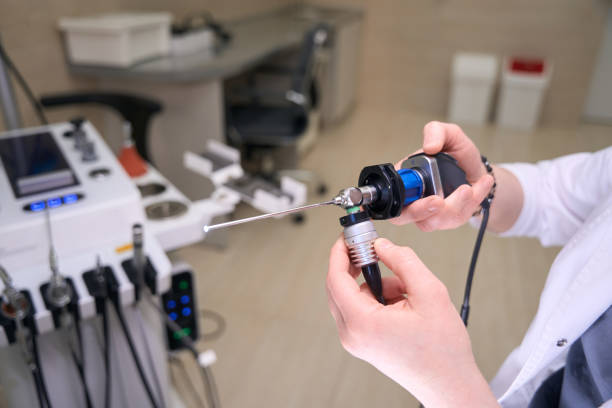
The endoscope is the central component of the system. In ENT practice, the two most common groups are rigid endoscopes and flexible endoscopes.
Rigid Endoscope
A rigid endoscope has a shaft that maintains a fixed shape and commonly uses an optical system to transmit images from the distal end to the eyepiece.
Depending on the intended use, rigid endoscopes may be designed to visualize areas such as:
- Ear canal and tympanic membrane.
- Nasal cavity.
- Relevant structures during nasal and sinus examinations.
- Larynx when an appropriate endoscope is used.
Rigid endoscopes are available in different diameters, working lengths, and viewing angles.
When selecting an endoscope, facilities should review:
- Outer diameter.
- Working length.
- Direction of view.
- Field of view.
- Optical-system quality.
- Light-source connector.
- Camera compatibility.
- Permitted reprocessing methods.
Rigid endoscopes should not be assumed to be interchangeable, even when they use the same camera system.
Flexible Endoscope
A flexible endoscope has a flexible insertion section and may include a mechanism for controlling the direction of the distal tip.
In ENT practice, one common device is the flexible nasopharyngolaryngoscope.
Depending on the design, the device may use:
- Fiber optics for image transmission.
- Integrated image sensors.
- External light sources or integrated illumination systems.
- Distal-tip steering controls.
- Other specialized accessories.
Some flexible endoscopes include a working channel, but not every model is designed to allow instruments to pass through the endoscope.
Comparison of Rigid and Flexible Endoscopes
| Criterion | Rigid Endoscope | Flexible Endoscope |
|---|---|---|
| Structure | Shaft maintains a fixed shape | Flexible shaft; distal tip may be steerable depending on the design |
| Imaging system | Usually uses optics combined with an eyepiece/camera | May use fiber optics or an integrated image sensor |
| Viewing capability | Depends on diameter, length, and direction of view | Depends on flexibility and steering capability |
| Camera connection | Usually uses a compatible camera head | Depends on whether it is a fiberoptic or video endoscope |
| Reprocessing | Depends on material, design, and manufacturer instructions | Requires particular attention to complex construction, inspection, and drying |
| Maintenance cost | Depends on the optical system and construction | May involve specific technical requirements for the insertion section and steering components |
The type of endoscope should be selected according to the intended use stated by the manufacturer and the professional requirements of the healthcare facility, rather than simply according to image clarity.
2. Components of an ENT Endoscopy System
A camera-based endoscopy system typically consists of multiple components working together to generate, process, and display images.
| Component | Primary Function |
|---|---|
| Endoscope | Provides visualization of the area being examined |
| Light source | Provides illumination to the observation area |
| Light cable | Transmits light from the source to the endoscope where required by the design |
| Camera head | Acquires optical images from a compatible endoscope |
| Camera processor | Processes image signals, color, and other image characteristics |
| Monitor | Displays endoscopic images |
| Recording device | Stores still images and video where supported |
| Software | Manages image data, information, and reports |
| Trolley/accessories | Supports system organization and operation |
Endoscopy Light Source
The light source illuminates the area to be observed through an optical system or an integrated illumination mechanism.
Common light-source technologies include:
- LED.
- Xenon.
- Other specialized illumination systems.
LED light sources are widely used in many modern endoscopy systems because of their design characteristics related to service life and energy efficiency.
However, a light source should not be selected solely according to whether it uses LED or Xenon technology.
Facilities should review:
- Light intensity and adjustability.
- Color-rendering characteristics.
- Compatibility with the endoscope.
- Service life of the light-emitting component.
- Maintenance requirements.
- Thermal management of the system.
The light source and light cable should be used in the correct configuration to reduce risks related to heat and component damage.
Camera Head and Image Processor
In systems using endoscopes with eyepieces, the camera head is generally connected at an appropriate location to acquire the image.
The signal is then transmitted to the processor to create an image for display on the monitor.
Supported functions may include:
- White balance.
- Brightness adjustment.
- Color processing.
- Digital image magnification.
- Image and video recording.
- Display-mode adjustment.
Not every system includes all of these functions.
Video endoscopes with distal image sensors may use dedicated connection methods and processors instead of a conventional external camera head.
Endoscopy Monitor
The monitor should support clear visualization under the lighting conditions and spatial constraints of the examination room.
When selecting a monitor, facilities should evaluate:
- Size appropriate to the viewing position.
- Resolution.
- Brightness.
- Color reproduction.
- Viewing angle.
- Connection ports.
- Cleanability of the surface.
A larger or higher-resolution display does not automatically provide better endoscopic image quality if the input image is limited by the endoscope or camera.
3. What Factors Affect Endoscopic Image Quality?

Image quality is often one of the first criteria considered when purchasing ENT endoscopy equipment.
However, the displayed image is the result of the entire imaging chain, not only the camera.
Optical Characteristics of the Endoscope
Specifications that may need to be reviewed include:
- Endoscope diameter.
- Working length.
- Direction of view.
- Field of view.
- Light-transmission capability.
- Lens characteristics.
- Image quality across different areas of the frame.
For example, endoscopes with different viewing directions may serve different visualization needs even when connected to the same camera.
Therefore, facilities should evaluate the actual endoscope configuration they intend to use rather than relying on images produced by a different demonstration endoscope.
Full HD and 4K Resolution
Modern endoscopy systems may be marketed as supporting Full HD or 4K display.
However, facilities should distinguish between:
- Camera-sensor resolution.
- Signal-processing and output resolution.
- Monitor resolution.
- Actual optical quality of the endoscope.
A 4K camera does not mean that the entire system will produce equivalent 4K-quality images under all conditions.
If other components are not suitable, the benefit of a high-resolution camera may be limited.
Brightness and Color Reproduction
Endoscopic images require appropriate illumination to support visualization.
During evaluation, facilities should consider:
- Is the image sufficiently bright in the intended observation area?
- Is color reproduction stable?
- Are there excessively bright or dark areas?
- How does white balance perform?
- Does image quality change significantly when the endoscope is changed?
Image quality should not be judged only from promotional images or edited videos.
Latency and Recording Capability
If the system is used to support real-time visualization, continuous display performance and image latency should be evaluated.
For data-recording functions, facilities should determine whether the resolution of stored images or video corresponds to the quality of the live image.
A clear live image displayed on the monitor but a lower-quality saved file is one issue that should be checked during a demonstration.
4. Compatibility Between the Endoscope, Camera, and Light Source
One common issue when investing in an endoscopy system is purchasing separate components without fully confirming their connectivity and compatibility.
A system may consist of components from the same manufacturer or may be configured using compatible components from different sources.
However, products with visually similar connectors should not automatically be assumed to operate together correctly.
Connections That Should Be Confirmed
| Connection Point | What Should Be Checked? |
|---|---|
| Endoscope – camera head | Connector, eyepiece, adapter, and focusing capability |
| Endoscope – light source | Light-cable connector, light transmission, and thermal requirements |
| Camera – processor | Connection interface and supported versions |
| Processor – monitor | Signal standard, connection ports, and resolution |
| Processor – recorder | Signal format and image/video storage capability |
| Software – hospital system | Data formats, connection methods, and patient information management |
For example, manufacturers such as KARL STORZ provide modular endoscopy systems as well as integrated systems combining cameras, light sources, displays, and recording functions.
This illustrates that facilities may choose different configurations according to their intended use, but compatibility must still be confirmed for the exact models and accessories.
Can the Camera Be Upgraded While Keeping Existing Endoscopes?
This may be possible in some cases, but facilities should confirm:
- Is the endoscope compatible with the new camera head?
- Is an adapter required?
- Is the optical quality sufficient?
- Is the existing light source appropriate?
- Do the software and recording system also need to be upgraded?
Upgrading the camera should not be assumed to guarantee an improvement in overall image quality.
5. Cleaning, Disinfection, and Sterilization Requirements for Endoscopes
Endoscope reprocessing is one of the most important requirements when implementing an ENT endoscopy system.
Depending on the intended use, endoscopes may come into direct contact with mucous membranes or other tissues. Equipment selection therefore needs to account for appropriate cleaning and reprocessing between patients.
According to the CDC, heat-sensitive endoscopes that contact mucous membranes, including certain nasopharyngoscopes, should be thoroughly cleaned and receive at least high-level disinfection (HLD) after each use when classified as semicritical devices.
In contrast, instruments used to enter sterile tissue or sterile areas are classified as critical devices and require appropriate sterilization.
This means the same level of reprocessing should not be applied to every ENT endoscope without considering its intended use.
Cleaning Before Disinfection
Reprocessing should begin with appropriate cleaning to remove residual soil from the device.
A general workflow may include:
Receiving the used endoscope → cleaning → inspection → appropriate disinfection or sterilization → drying → storage
The specific steps depend on manufacturer instructions and the facility's procedures.
Flexible endoscopes may have more complex internal structures and may require additional inspection activities.
Leak Testing of Flexible Endoscopes
Some reusable flexible endoscopes require a leak test according to manufacturer instructions.
The purpose is to help detect damage that could allow fluid to enter components not designed for fluid exposure.
However, not every endoscope has the same leak-testing method or requires testing in the same way.
When selecting equipment, facilities should clarify:
- Is leak testing required?
- Which accessories are required?
- At what stage is the test performed?
- What action should be taken if a fault is detected?
High-Level Disinfection and Sterilization
High-level disinfection and sterilization are different levels of reprocessing.
Facilities should determine:
- Type of instrument being used.
- Required reprocessing level according to risk classification.
- Methods permitted by the manufacturer.
- Compatible chemicals or processing equipment.
- Drying and storage requirements.
In particular, it should not be assumed that every rigid endoscope can be steam sterilized or that every flexible endoscope is compatible with all high-level disinfectants.
Even if an endoscope can tolerate a particular processing method, connectors, cables, or accessories may have separate requirements.
Can an Automated Endoscope Reprocessor Be Used?
Some healthcare facilities use an Automated Endoscope Reprocessor (AER).
However, the AER system and its connectors must be confirmed as compatible with the specific type of endoscope.
An AER does not automatically replace all manual cleaning steps or inspections required by the manufacturer.
ANSI/AAMI ST91:2021 provides guidance on the reprocessing of flexible and semi-rigid endoscopes in healthcare facilities, including flexible ENT endoscopes.
6. Endoscopic Image Storage and Data Connectivity
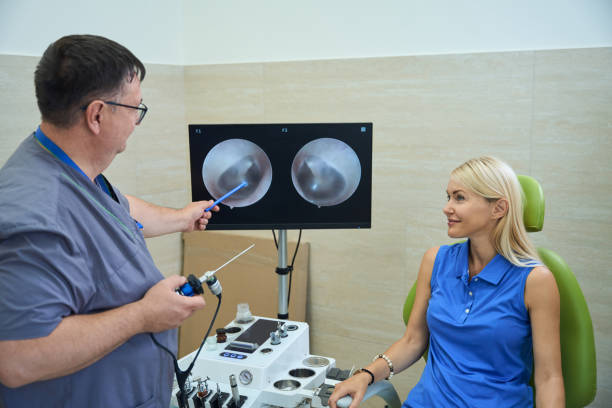
Endoscopic images may be used to support record keeping, retrospective review, or professional communication.
Depending on the configuration, the system may support:
- Still-image capture.
- Video recording.
- Linking patient information.
- Storage by date and examination encounter.
- File export.
- Internal network connectivity.
- Integration with management software.
Recording Capability Does Not Necessarily Mean Complete Record Management
A system that can save images to a USB drive does not necessarily include complete patient-data management software.
When evaluating a system, facilities should check:
- In which formats are images and videos stored?
- Can records be searched by Patient ID?
- Are notes or reports supported?
- Can data be exported to another computer?
- Is proprietary software required to open the files?
- Can data be backed up and restored?
If the hospital requires integration with HIS/EMR, protocols, data formats, and the integration approach should be confirmed for the exact system.
The presence of USB, LAN, or Wi-Fi connectivity does not mean that the device can automatically connect to the electronic medical record system.
Data Access Management
Endoscopic images and videos may contain patient-related information.
Facilities should therefore evaluate:
- User access permissions.
- Data retrieval capability.
- Access logs where supported.
- Backup arrangements.
- Data-retention period.
- Methods for managing and protecting data.
For clinics with multiple physicians or multiple endoscopy rooms, centralized management software may help organize data more conveniently.
7. Operational and Maintenance Requirements for ENT Endoscopy Systems
The endoscopy system should be arranged appropriately for the examination space and reprocessing workflow.
Space and Infrastructure
Facilities should review:
- Monitor position.
- Working distance.
- Location of the light source and processor.
- Cable-management system.
- Electrical power and grounding.
- Trolley or mounting system.
- Endoscope-storage space.
- Area for receiving and reprocessing equipment.
For clinics with limited space, an integrated system may reduce the number of separate devices.
However, upgradeability and repair options should be evaluated in case one component fails.
Periodic Maintenance
The equipment-management program may include:
- Visual inspection of endoscopes.
- Inspection of lenses and image quality.
- Inspection of light cables.
- Inspection of the camera head.
- Testing of light-source functions.
- Checking distal-tip steering on flexible endoscopes.
- Inspection of cables and connectors.
- Testing of recording and data-storage functions.
- Inspection of reprocessing accessories.
Inspection schedules should be based on manufacturer instructions and the level of use.
In particular, flexible endoscopes may require specific inspections of steering performance, integrity, and components that are more susceptible to damage.
Number of Backup Endoscopes
If a facility performs multiple endoscopic examinations each day, purchasing only one endoscope for each examination room may not be sufficient for operations.
Facilities should account for:
- Expected number of uses.
- Reprocessing time.
- Drying and storage time.
- Simultaneous-use requirements.
- Repair time when an endoscope is damaged.
Actual service capacity depends on the number of endoscopes available and ready for use, not only on the number of cameras or monitors installed.
8. Integrated Endoscopy System or Modular Configuration?
When investing in equipment, facilities may choose between compact systems integrating multiple components and systems using separate modules.
| Criterion | Integrated System | Modular System |
|---|---|---|
| Configuration | Multiple functions integrated into one device | Camera, light source, monitor, and recorder may be separate |
| Space | May be more compact | Requires space for multiple components |
| Mobility | May be convenient depending on the design | Depends on trolley and overall configuration |
| Upgradeability | Depends on the system architecture | May offer greater flexibility when components are compatible |
| Maintenance | Ability to repair individual components should be evaluated | Individual components may be replaceable depending on the design |
| Cost | Depends on configuration and accessories | Depends on the number of modules and connectivity requirements |
There is no single configuration suitable for every healthcare facility.
ENT clinics that mainly require routine visualization and image storage may prioritize compactness and ease of use.
Hospitals with multiple endoscopy rooms or more advanced procedural requirements may need systems that support expansion and multiple types of endoscopes.
Selection should be based on the facility's professional scope and the configuration stated by the manufacturer.
9. Ten Criteria for Selecting ENT Endoscopy Equipment
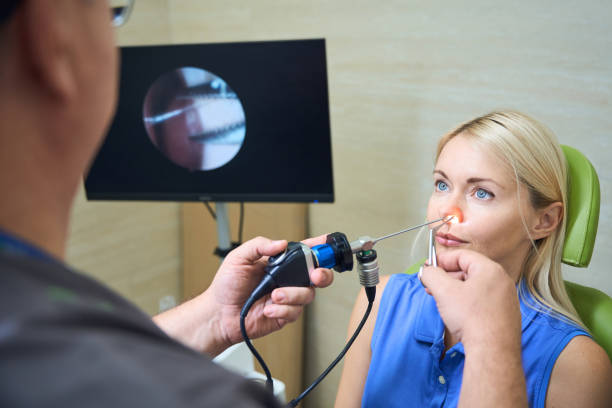
Hospitals and clinics may use the following framework to compare systems:
| Criterion | What Should Be Evaluated? |
|---|---|
| 1. Intended use | Endoscopy of the ear, nose, throat, larynx, or appropriate specialist procedures |
| 2. Endoscope type | Rigid or flexible endoscope, diameter, length, and direction of view |
| 3. Image quality | Optics, resolution, illumination, and color reproduction |
| 4. Camera and processing | Sensor, camera head, processor, and display modes |
| 5. Compatibility | Connections between the endoscope, camera, light source, and monitor |
| 6. Data storage | Image capture, video recording, reports, and connectivity where required |
| 7. Reprocessing | Cleaning, disinfection, sterilization, and storage instructions |
| 8. Operational capability | System size, interface, space requirements, and number of endoscopes |
| 9. Technical service | Warranty, maintenance, replacement endoscopes, spare parts, and training |
| 10. Lifecycle cost | Main system, endoscopes, accessories, reprocessing supplies, software, and repairs |
Common Selection Mistakes
Looking only at camera resolution: Failing to evaluate optical quality, light source, and compatibility across the complete system.
Selecting endoscopes only by diameter: Overlooking working length, direction of view, and intended use.
Failing to check connectivity: The camera, light source, or light cable may not be compatible with existing endoscopes.
Overlooking reprocessing requirements: The system may be difficult to implement because the facility does not have an appropriate cleaning or disinfection method.
Failing to plan for backup endoscopes: Examinations may be interrupted while an endoscope is undergoing reprocessing or repair.
Considering only the purchase price: Failing to budget for replacement cables, optical repairs, reprocessing supplies, and software.
10. Questions to Ask Suppliers Before Purchasing
Before selecting an ENT endoscopy system, healthcare facilities should clarify:
1. For which ENT examinations and procedures is the equipment designed?
2. Which types of rigid and flexible endoscopes does the system support?
3. What are the stated diameter, length, direction-of-view, and field-of-view specifications?
4. Are the camera, light source, and monitor fully compatible as a system?
5. Under what conditions is actual image quality evaluated?
6. Can the system store images and video and connect with patient-management software?
7. What cleaning, disinfection, or sterilization method is required for each type of endoscope?
8. Does the facility need additional reprocessing equipment or specialized accessories?
9. How are replacement endoscopes, camera heads, light cables, and other components supplied?
10. What costs are included in multi-year investment, reprocessing, maintenance, and replacement?
These questions should be checked against technical documentation for the exact model and confirmed through practical demonstration before finalizing the configuration.
Frequently Asked Questions About ENT Endoscopy Equipment
What Does an ENT Endoscopy System Include?
A system may include an endoscope, light source, camera head, image processor, monitor, recording device, and compatible accessories. Some systems integrate multiple functions into a single unit.
What Is the Difference Between Rigid and Flexible ENT Endoscopy?
A rigid endoscope has a fixed shaft and is designed with optical characteristics appropriate to its intended use. A flexible endoscope has a flexible insertion section and may support visualization through curved anatomical pathways or other areas appropriate to its design.
Is a 4K Endoscopy Camera Always Better Than Full HD?
Not necessarily. Image quality depends on the complete imaging chain, including the endoscope, light source, sensor, processor, and monitor.
Do ENT Endoscopes Need to Be Sterilized After Every Use?
The required level of reprocessing depends on the intended use and risk classification. Endoscopes that contact mucous membranes and are classified as semicritical generally require at least high-level disinfection when reused, while instruments entering sterile tissue or sterile areas require sterilization. Manufacturer instructions and facility procedures should be followed.
Can One Endoscopy Camera Be Used with Different Types of Endoscopes?
Yes, if the components are confirmed as compatible. Facilities should check the connector, adapter, focusing capability, light source, and image quality for the exact configuration.
Does a Clinic Need Endoscopy Image-Storage Software?
This depends on operational needs. If the clinic needs to store images and video and link data to patient records, image-management software and backup capability should be evaluated from the investment-planning stage.
This article is provided for informational purposes regarding the components, functions, and selection criteria for ENT endoscopy equipment. It does not provide procedural instructions or diagnostic guidance. Equipment use, cleaning, disinfection, sterilization, and maintenance should follow manufacturer instructions, professional procedures, and applicable facility requirements. The international standards mentioned are technical references and do not automatically constitute mandatory legal requirements in Vietnam.
Explore ENT Endoscopy Systems and Diagnostic Solutions at Pharmedi Vietnam 2027
For hospitals and ENT specialty clinics, investing in an endoscopy system involves more than selecting a high-resolution camera. Appropriate endoscopes, light sources, image-recording capability, reprocessing procedures, and maintenance services all affect long-term usability.
Pharmedi Vietnam 2027, taking place from September 28–30, 2027 at the Saigon Exhibition and Convention Center (SECC), Ho Chi Minh City, provides an opportunity for businesses, professionals, and healthcare organizations to meet, explore technologies, and discuss equipment solutions that support healthcare delivery.
For facilities preparing to invest in or upgrade ENT endoscopy systems, Pharmedi Vietnam 2027 provides an opportunity to explore technology solutions, identify potential suppliers, and define the technical requirements that should be evaluated when selecting specialty endoscopy equipment.
Technology groups worth exploring include ENT endoscopes, endoscopy camera systems, light sources, display monitors, and image-management solutions. Understanding how these components work together can help facilities evaluate system compatibility before investing.
When discussing solutions with suppliers, hospitals and clinics may proactively explore:
- For which uses are the rigid and flexible endoscopes designed?
- Are the camera, light source, and monitor compatible with the endoscopes already in use?
- Does actual image quality meet the requirements for visualization and record keeping?
- Does the system support image capture, video recording, and data management?
- What reprocessing methods and accessories are required for each type of endoscope?
- Does the supplier provide long-term training, maintenance, and endoscope replacement support?
Preparing these criteria helps healthcare facilities compare solutions, assess compatibility with their existing systems, and develop an investment plan appropriate to their specialty-care needs.
For ENT endoscopy systems, an appropriate choice should be based on the integration of the endoscope, image quality, infection-control requirements, and the facility's operational capability, rather than comparing only a few camera specifications.
Dates: September 28–30, 2027
Venue: Saigon Exhibition and Convention Center (SECC), Ho Chi Minh City
Exhibition Information: https://pharmed.vn/
Product Categories: https://pharmed.vn/exhibitors/products
Exhibitor registration, visitor registration, and program information will be updated according to official announcements from the Pharmedi Vietnam 2027 Organizing Committee.