

A central medical gas system is a technical infrastructure system designed to deliver medical gases and vacuum services to points of use throughout a hospital via dedicated pipeline networks. It can support intensive care, emergency medicine, anesthesia, surgery, and various other clinical activities.
In healthcare facilities, a hospital medical gas system typically includes an oxygen supply, medical compressed air system, medical vacuum system, distribution pipework, pressure regulators, area shut-off valves, terminal units, and monitoring and alarm systems.
When investing in medical gas infrastructure, hospitals should assess demand, gas quality, backup supplies, the ability to maintain pressure and flow, pipeline safety, alarm systems, and long-term maintenance capabilities.
What Is a Central Medical Gas System?
A central medical gas system, also known as a Medical Gas Pipeline System (MGPS), supplies and distributes medical gases or vacuum from centralized sources to points of use within a healthcare facility.
A system may serve areas such as:
- Intensive Care Units (ICUs).
- Emergency Departments.
- Operating rooms.
- Departments of Anesthesia and Critical Care.
- Inpatient wards.
- Procedure rooms.
- Other clinical areas requiring medical gases.
ISO 7396-1:2016 addresses requirements for medical gas pipeline systems related to supply sources, distribution networks, control, monitoring, alarms, and prevention of cross-connections between different gases.
In Vietnam, TCVN 8022-1:2009 — Medical gas pipeline systems, Part 1: Pipeline systems for compressed medical gases and vacuum — is a national standard directly relevant to this field.
Which Gases Are Included in a Central Medical Gas System?
Not every hospital uses the same range of medical gases.
Depending on the size and specialties of the facility, the system may include:
| Gas or Service | English Name | General Application |
|---|---|---|
| Medical oxygen | Medical Oxygen | Supplies oxygen for appropriate treatments and compatible equipment |
| Medical compressed air | Medical Air | Supplies air of controlled quality for respiratory equipment and other medical applications |
| Medical vacuum | Medical Vacuum | Provides negative pressure for suction systems and suitable applications |
| Nitrous oxide | Nitrous Oxide | Used in certain anesthesia applications within the appropriate clinical scope |
| Medical carbon dioxide | Medical Carbon Dioxide | Used in suitable medical applications |
| Gas for surgical instruments | Surgical Air/Nitrogen | Provides pneumatic power to instruments designed for compatibility |
Medical vacuum is not a gas supplied under positive pressure. Rather, it is a service that creates pressure below ambient pressure for appropriate applications.
1. Main Components of a Central Medical Gas System
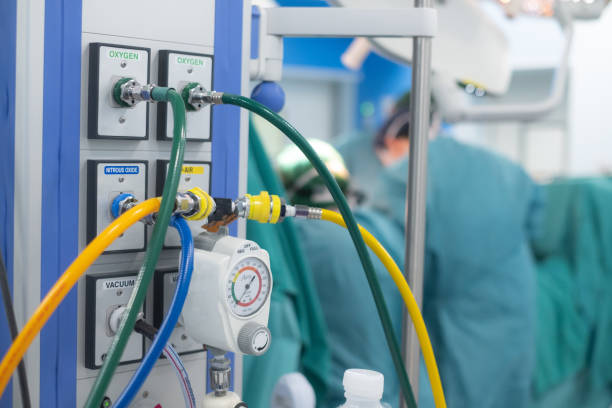
- Gas supply sources or vacuum generation systems.
- Pressure regulation and quality-control systems.
- Distribution pipeline network.
- Shut-off valves and area-control equipment.
- Medical gas terminal units.
- Monitoring, alarm, and backup systems.
Central Supply Sources
The supply source is where medical gas is generated, stored, or received before entering the distribution network.
Examples include:
- Liquid oxygen storage tanks.
- Oxygen cylinder manifolds.
- Pressure Swing Adsorption (PSA) oxygen generation plants.
- Medical air compressors.
- Central vacuum pump stations.
Pressure Regulation System
The pressure regulation system controls pressure from the supply source before distribution to clinical areas.
Components may include:
- Pressure regulators.
- Supply changeover valves.
- Pressure gauges.
- Gas filters.
- Safety valves.
- Other control devices specified by the design.
Distribution Pipeline Network
Pipelines must meet requirements relating to materials, cleanliness, pressure resistance, identification, and connection safety.
Each gas or vacuum service must have a suitable distribution network to prevent accidental cross-connections.
Area Shut-Off Valves
Shut-off valves allow designated sections of the system to be isolated for inspection, maintenance, or fault response under approved procedures.
Medical Gas Terminal Units
Terminal units are the points where medical gas or vacuum services are connected to equipment.
- Bedhead locations.
- Treatment-room walls.
- Bedhead service panels.
- Operating-room pendants.
- Other specially designed locations.
Monitoring and Alarm System
Alarm systems help personnel identify abnormal conditions, such as incorrect pressure, supply-source failures, or operation on a backup source.
2. Central Oxygen Supply Systems in Hospitals
In Vietnam, the Ministry of Health issued Decision No. 2747/QD-BYT on August 27, 2025, together with guidance on establishing medical oxygen systems for healthcare facilities.
Liquid Oxygen (LOX) Supply
Liquid oxygen (LOX) is stored in specialized tanks at extremely low temperatures.
Before being introduced into the pipeline network, liquid oxygen is converted into gas through an appropriate vaporization system.
LOX supply is often considered for hospitals with high and relatively stable oxygen demand.
However, the system requires evaluation of:
- Storage tank capacity.
- Continuous oxygen delivery capacity.
- Vaporization system.
- Arrangements for receiving additional oxygen deliveries.
- Pressure-control capability.
- Safety measures for cryogenic storage equipment.
- Supply continuity and backup arrangements.
Oxygen Cylinder Manifold Supply
An oxygen cylinder manifold connects multiple oxygen cylinders to a pressure-regulation and supply-changeover system.
Depending on the design, a cylinder manifold may serve as:
- The primary supply.
- A secondary supply.
- A backup supply.
Evaluation should cover:
- Number of cylinders and storage capacity.
- Cylinder storage arrangements.
- Source changeover capability.
- Pressure-regulation system.
- Alarm functions.
- Cylinder replacement and delivery procedures.
- Reliability of the oxygen supplier.
PSA Oxygen Generation Plant
Pressure Swing Adsorption (PSA) is a technology that separates oxygen from air using pressure-dependent adsorption.
The system uses suitable adsorbent materials to remove part of the nitrogen from the air, producing a gas stream with a higher oxygen concentration.
A PSA plant may include:
- An inlet air compressor.
- Air treatment and purification systems.
- Adsorption units.
- Buffer tanks.
- Oxygen concentration monitoring equipment.
- A control system.
- Safety devices and auxiliary equipment.
According to WHO, oxygen produced by PSA systems is commonly designated Oxygen 93, with an oxygen concentration of approximately 90–96% under the applicable specification.
This product should be distinguished from medical oxygen produced by air liquefaction, which is subject to different purity requirements.
When selecting a PSA plant, hospitals should evaluate:
- Oxygen output capacity.
- Oxygen quality under applicable standards.
- Stability of oxygen concentration.
- Electrical power requirements.
- Inlet air quality.
- Cooling system.
- Consumables and filters.
- Maintenance capability.
- Backup arrangements if the plant stops operating.
A bedside oxygen concentrator and a PSA plant supplying a central pipeline network are not equivalent in capacity, function, or infrastructure requirements.
Comparison of Oxygen Supply Sources
| Criterion | Liquid Oxygen (LOX) | Oxygen Cylinder Manifold | PSA Oxygen Plant |
|---|---|---|---|
| Oxygen source | Delivered liquid oxygen that is vaporized before use | Compressed gaseous oxygen in cylinders | Oxygen generated from air |
| Main characteristic | Large-volume storage | Capacity can be adjusted through cylinder quantity | On-site oxygen production |
| Infrastructure requirements | Storage tank, vaporizer, and cryogenic safety | Cylinder storage, manifold, and pressure regulation | Electricity, compressors, air treatment, and cooling |
| External dependencies | Liquid oxygen deliveries | Cylinder delivery and replacement | Electricity, maintenance, and consumables |
| Operating costs | Supply, maintenance, and storage | Transportation, cylinder replacement, and stock management | Electricity, consumables, and equipment maintenance |
| Backup role | Can form part of a backup configuration | Commonly used as a backup supply | Can form part of a backup configuration |
3. How Does a Medical Compressed Air System Work?
A Medical Air System supplies air of controlled quality to compatible medical equipment and applications.
Unlike ordinary industrial compressed air, medical air is subject to specific requirements concerning gas composition, cleanliness, and contaminants.
Components of a Medical Air System
A medical air plant may include:
- Air compressors.
- Air receivers.
- Air dryers.
- Filters.
- Pressure monitoring systems.
- Air-quality control equipment.
- Controllers and alarms.
- Backup supply systems.
Why Must Medical Compressed Air Be Treated?
Incoming air may contain moisture, dust, oil vapor, or other contaminants.
Compression can change the temperature and moisture conditions within the system.
The air must therefore be treated to meet the required quality specifications before distribution.
Factors commonly requiring control include:
- Moisture content.
- Particulate matter.
- Oil and oil vapor.
- Carbon monoxide.
- Inappropriate gas components.
- Microbiological quality, where required.
Air quality must be evaluated using appropriate standards and measurement methods.
Is Medical Air the Same as Air Used for Surgical Instruments?
They should not automatically be considered equivalent.
Some hospitals use one air system for respiratory support and another compressed gas system to power surgical instruments.
These services may differ in intended use, technical requirements, and distribution configuration.
Design documents should therefore distinguish each gas service and its intended applications.
Can an Industrial Air Compressor Be Used for a Medical Gas System?
Air from an ordinary industrial compressor should not be introduced directly into the medical gas network unless the complete system has been designed, treated, and verified to meet the relevant quality requirements.
The ability of a compressor to produce the correct pressure does not demonstrate that its output air is suitable for patient use.
4. Medical Vacuum Systems
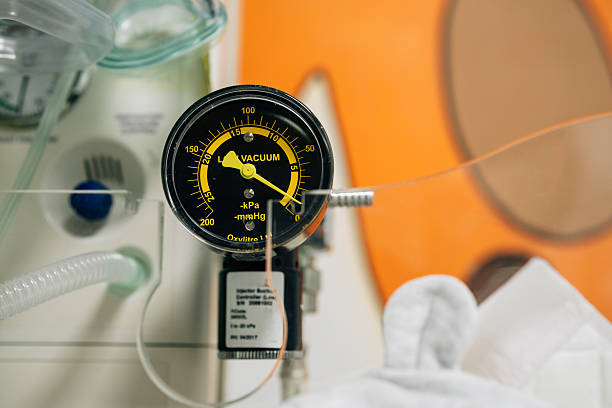
A central Medical Vacuum System generates and maintains negative pressure for compatible medical equipment and applications.
Main Components
A vacuum plant may include:
- Vacuum pumps.
- Vacuum receivers.
- Filters and protective components.
- Valve systems.
- Controllers.
- Pressure sensors.
- Alarm systems.
- An appropriate exhaust discharge line.
Depending on the configuration, multiple pumps may be used to maintain operation when one pump fails or requires maintenance.
Role of a Central Vacuum Supply
The vacuum supply may serve suction equipment or other suitable clinical applications.
At the point of use, the vacuum source connects to a regulator and collection system according to the design.
A central vacuum supply should be distinguished from a standalone medical suction machine.
A standalone suction machine may have its own vacuum pump, while equipment using central suction receives negative pressure from the hospital's vacuum network.
Is a Medical Vacuum System the Same as an Anesthetic Gas Scavenging System?
No.
An Anaesthetic Gas Scavenging System (AGSS) is designed to collect and remove excess anesthetic gases through an appropriate mechanism.
A medical vacuum system, by contrast, serves specifically designed suction applications.
The two systems may use different methods of generating negative pressure and must not be interconnected arbitrarily.
ISO 7396-2:2007 specifies separate requirements for anesthetic gas scavenging disposal systems.
5. Medical Gas Pipeline Networks in Hospitals
Safe operation depends on pipe materials, installation quality, routing, identification, and post-installation testing.
Pipe Materials
Specialized copper tubing for medical gases is commonly used because it can meet specific cleanliness and technical requirements.
Depending on the applicable standard, systems may refer to requirements for copper tubing such as EN 13348 or other accepted equivalent materials.
Selection criteria include:
- Material composition.
- Pressure resistance.
- Internal cleanliness.
- Gas compatibility.
- Storage conditions.
- Joining methods.
- Supporting quality documentation.
Cleanliness Requirements
Internal contamination is a critical factor that must be controlled in medical gas pipelines.
Contaminants may include:
- Oil and grease.
- Particulates.
- Debris from construction activities.
- Moisture.
- Other incompatible substances.
Oxygen systems, in particular, require strict control of materials and substances that may increase fire hazards in an oxygen-enriched environment.
Pipeline Routing and Identification
Each gas must be distributed through appropriate pipelines and connection systems.
Requirements to evaluate include:
- Pipeline routing diagrams.
- Gas identification symbols.
- Identification markings.
- Flow-direction indications where needed.
- Accessibility for inspection.
- Shut-off valve locations.
- Mechanical protection measures.
Pipelines and connection points should not be identified by color alone.
Labels, symbols, and gas-specific connection systems should be used according to the applicable standards.
Why Must Cross-Connections Be Prevented?
Incorrect connections between gas networks may cause equipment to receive a gas different from the one intended for use.
This is a serious risk in medical gas systems.
ISO 7396-1 and TCVN 8022-1 therefore emphasize preventing cross-connections between different gas networks, together with testing and verification before commissioning.
6. Pressure Regulators, Area Shut-Off Valves, and Terminal Units
Pressure Regulators
A pressure regulator controls gas pressure from the source or within sections of the distribution network.
Selection should include verification of:
- Compatible gas type.
- Operating pressure range.
- Ability to maintain flow.
- Materials.
- Protective systems.
- Inspection and maintenance accessibility.
ISO 10524-2:2018 is an international standard addressing manifold and line pressure regulators used in medical gas systems.
Area Shut-Off Valves
Area Valve Service Units (AVSUs) are installed to facilitate the isolation of specified system areas.
These valves may be used during maintenance or to respond to abnormal conditions under approved procedures.
Factors to evaluate include:
- Installation location.
- Area served.
- Accessibility.
- Gas identification.
- Pipeline diagrams.
- Protection against unauthorized operation.
- Operating documentation and instructions.
For critical departments such as ICUs and operating rooms, the consequences of isolating an area must be evaluated particularly carefully.
Medical Gas Terminal Units
A terminal unit is the connection point between the pipeline network and equipment at the point of use.
Terminal units are generally designed with gas-specific connection features.
The purpose is to reduce the risk of connecting equipment to an inappropriate gas supply.
ISO 9170-1:2017 specifies requirements for design, connection characteristics, leak tightness, non-interchangeability, and performance of terminal units for compressed medical gases and vacuum.
When investing in terminal units, facilities should confirm:
- The connection standard used.
- Compatibility with connected equipment.
- Leak tightness.
- Resistance to mechanical stresses.
- Maintenance and replacement capability.
- Consistency across departments.
Even a correctly designed terminal unit may present risks if it is used with an unsuitable adapter.
Facilities must therefore control the accessories and connecting hoses used with the system.
7. Medical Gas Monitoring and Alarm Systems
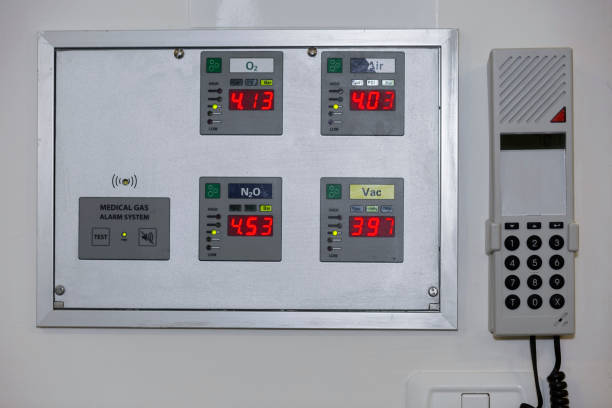
Monitoring and alarm systems help personnel recognize conditions that may affect gas supply availability.
Depending on the design, alarms may be installed at:
- Gas supply plants.
- Technical equipment rooms.
- Central management areas.
- Clinical departments.
- Area alarm panels.
Common Alarm Categories
| Alarm Category | Monitored Condition |
|---|---|
| Source pressure | Pressure status at the supply source |
| Pipeline pressure | Pressure outside the specified limits in a monitored area |
| Backup supply | Changeover status or use of a backup source |
| Oxygen supply | Supply condition and monitored quality indicators |
| Medical air | Compressor, air treatment equipment, and related operating parameters |
| Medical vacuum | Pump status and vacuum level |
| Technical equipment | Faults affecting fans, pumps, power supplies, or integrated components |
Not every system can monitor all the parameters listed above.
Specific functions must be verified against the system design and supplied documentation.
Central Alarms and Area Alarms
Central alarms generally help technical staff monitor the status of supply sources and major system components.
Area alarms may be located in clinical departments to report abnormalities affecting the distribution network serving those areas.
An alarm system located only in the plant room may not adequately meet the monitoring needs of departments using medical gases.
Is Integration with a Building Management System Necessary?
Some hospitals operate a Building Management System (BMS) for centralized facility monitoring.
A medical gas system may transmit data to the BMS to support centralized supervision.
However, integration should clarify:
- Which data are transmitted.
- Which alarms require priority.
- What happens if connectivity is lost.
- Historical logging capabilities.
- Responsibility for receiving and responding to alarms.
- Safety and cybersecurity requirements.
BMS connectivity should not be treated as a substitute for any dedicated alarm system required by the design and applicable standards.
8. Backup Supplies and Continuous Gas Availability
If a system relies on only one supply source, a fault or maintenance activity may interrupt the entire service.
Primary and Backup Supplies
Under Vietnam's Ministry of Health Decision No. 2747/QD-BYT issued in 2025, medical oxygen supply systems for healthcare facilities must have a primary source and at least one backup system.
Suitable backup options may include:
- Oxygen cylinder manifolds.
- Liquid oxygen supplies.
- PSA oxygen generation plants.
- Validated combinations of supply sources.
The type and capacity of backup sources depend on demand, facility size, and the system design.
Does Backup Supply Simply Mean Adding Another Oxygen Cylinder?
No.
Factors to consider include:
- Gas supply sources.
- Supply changeover capability.
- Pressure-regulation system.
- Electrical power supply.
- Critical components of the supply plant.
- Monitoring capability.
- Repairability.
- Arrangements for gas supply during faults.
A backup cylinder manifold that cannot meet the design demand should not be regarded as a complete backup solution merely because it is installed.
Backup Electrical Power
Certain medical gas system components depend heavily on electrical power, including:
- Air compressors.
- PSA oxygen generation plants.
- Vacuum pumps.
- Control systems.
- Alarm equipment.
- Auxiliary components.
Facilities should therefore evaluate priority or backup power arrangements according to the design.
However, a standard uninterruptible power supply (UPS) should not be assumed capable of maintaining the entire gas plant.
The electrical load, backup duration, and equipment served must be clearly confirmed.
Planning for Supply Interruptions
Hospitals should establish arrangements for scenarios such as:
- Loss of the primary gas supply.
- Reduced pressure.
- Gas quality failing to meet specified requirements.
- Compressor faults.
- Power outages.
- Pressure regulator failures.
- Pipeline leaks.
- Maintenance of supply sources or distribution networks.
The plan should define coordination responsibilities among technical staff, clinical departments, and relevant parties.
Supply changeovers, pipeline isolation, and system restoration must be performed by authorized personnel under approved procedures.
9. Safety Requirements for Medical Gas System Operation
Medical Oxygen Safety
Oxygen is not a flammable fuel, but it strongly supports combustion.
An oxygen-enriched environment can increase fire risk and cause certain materials to ignite or burn more vigorously than under normal conditions.
Oxygen systems therefore require particular attention to:
- Oxygen-compatible materials.
- Control of oil and grease.
- Leak prevention.
- Appropriate electrical equipment.
- Safe supply-source arrangements.
- Fire prevention and protection measures.
- Maintenance management.
Maintenance materials or chemicals must not be used unless their compatibility with the oxygen system has been confirmed.
Pressure Safety
In compressed gas systems, incorrect pressure may affect the distribution network or connected equipment.
Protective components may include:
- Pressure regulators.
- Safety valves.
- Pressure gauges.
- Sensors.
- Alarm equipment.
- Other protective measures.
Pressure parameters must be established according to the gas type, equipment, and system design.
There is no single operating pressure applicable to all medical gases and all hospitals.
Gas Quality Safety
Gas supplies must be tested to confirm compliance with applicable quality requirements.
Depending on the gas type, quality indicators may include:
- Gas composition and concentration.
- Moisture content.
- Oil content.
- Particulates.
- Chemical impurities.
- Microbiological quality.
- Other indicators required by the method and standard.
Measuring pressure alone is insufficient to conclude that a gas supply meets medical quality requirements.
Connection Safety
Different gas systems must have appropriate identification and measures to prevent cross-connections.
Terminal units, connectors, hoses, and accessories must be evaluated together.
Incompatible adapters should not be used to connect equipment to a different gas service.
Operational and Personnel Safety
Hospitals should establish management procedures covering:
- Personnel authorized to operate the system.
- Personnel authorized to perform maintenance.
- Approval of intervention work.
- System handover.
- Alarm response.
- Change management.
- Periodic training.
- Incident recordkeeping.
These factors directly affect the ability to maintain safety, particularly in hospitals operating continuously.
10. Testing, Acceptance, and Evaluation Before Commissioning
Under TCVN 8022-1:2009 and ISO 7396-1:2016, testing extends beyond leak tightness to include identification, prevention of cross-connections, performance, and gas quality.
Pipeline Leak Testing
The purpose is to assess system leakage under appropriate test conditions.
The scope and methods of testing must be defined in the technical documentation.
Verification of Correct Gas Connections
This is a particularly important test to confirm that terminal units are connected to the intended gas or vacuum network.
Labels or colors alone cannot replace connection verification testing.
Supply Source Performance Testing
Tests may cover:
- Supply-source capacity.
- Pressure characteristics.
- Flow rates under design conditions.
- Pressure regulator operation.
- Source changeover.
- Backup supply capability.
Alarm System Testing
Critical alarms must be verified to operate as designed.
In addition to signals at the supply plant, alarm panels in clinical areas should be included in the evaluation plan.
Gas Quality Testing
Hospitals should verify that gases at appropriate sampling locations meet the specified quality requirements.
Acceptance testing should not rely only on certificates for the gas supply source while overlooking possible contamination introduced through the distribution network.
Documentation to Be Handed Over
Depending on the project, handover documentation may include:
- As-built drawings.
- Supply source and pipeline diagrams.
- Equipment and material schedules.
- Technical documentation.
- Inspection and test reports.
- Acceptance records.
- Operating instructions.
- Maintenance procedures.
- Spare parts lists.
- Training and handover records.
11. Maintenance and Monitoring of Central Medical Gas Systems
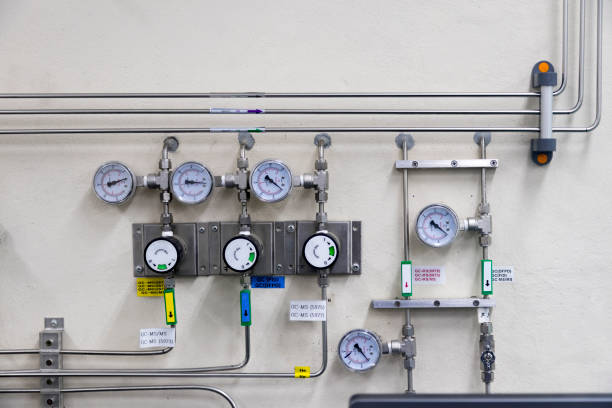
Maintenance must cover not only supply plants but also pipeline networks, shut-off valves, terminal units, and alarm equipment.
Oxygen Supply Maintenance
Depending on the technology, monitoring may include:
- Supply-source condition.
- Pressure-regulation equipment.
- Source changeover systems.
- Oxygen quality indicators.
- Valves and safety components.
- Vaporization systems where liquid oxygen is used.
- Compressors, filters, and adsorption units in PSA plants.
Medical Air System Maintenance
Maintenance activities may involve:
- Compressors.
- Filters.
- Air dryers.
- Air receivers.
- Quality-monitoring equipment.
- Control systems.
- Protective components.
Medical Vacuum System Maintenance
Items may include:
- Vacuum pumps.
- Vacuum receivers.
- Filters.
- Exhaust lines.
- Controllers.
- Alarms.
- Related components.
Inspection of Valves and Terminal Units
Facilities should maintain management records covering:
- Valve locations.
- Areas affected by each valve.
- Identification status.
- Connection condition.
- Leaks or damage.
- Inspection schedules.
- Repairs performed.
Incident Management
When an incident occurs, the response process should include:
- Recording alarms.
- Determining the extent of the impact.
- Assigning responsibilities.
- Coordinating with affected clinical departments.
- Implementing corrective measures under approved procedures.
- Testing before restoring service.
- Documenting the incident and assessing its causes.
12. Criteria for Selecting a Central Medical Gas System for Hospitals
| Criterion | What Should Be Evaluated? |
|---|---|
| 1. Demand | Bed capacity, departments, gas service requirements, and simultaneous demand |
| 2. Supply sources | Liquid oxygen, cylinder manifolds, PSA plants, medical air plants, and vacuum plants |
| 3. Gas quality | Applicable quality specifications and monitoring methods |
| 4. Backup supplies | Ability to maintain supply during failures or maintenance |
| 5. Pipeline network | Materials, cleanliness, leak tightness, routing, and identification |
| 6. Pressure regulation and valves | Pressure control and area isolation |
| 7. Terminal units | Connection standards and protection against interchangeability |
| 8. Monitoring and alarms | Source and area alarms and centralized monitoring capability |
| 9. Acceptance testing and technical services | Testing, training, maintenance, and support in Vietnam |
| 10. Lifecycle cost | Equipment, construction, gases, electricity, consumables, and maintenance |
Common Investment Mistakes
Calculating demand solely from bed numbers: Failing to assess simultaneous requirements in ICUs, operating rooms, and departments with different gas consumption profiles.
Investing only in a primary supply: Lacking the ability to maintain services when the primary source is unavailable.
Using unsuitable compressed air: Failing to verify air quality before introducing it into the system.
Testing only for leaks: Overlooking verification of correct gas connections, system performance, and gas quality.
Overlooking area alarms: Clinical staff may not recognize supply failures promptly.
Failing to verify terminal units: Creating compatibility risks with connected equipment.
Ignoring operating costs: Excluding electricity, gases, filters, spare parts, and maintenance services.
Failing to plan for expansion: The system may struggle to accommodate additional beds or new clinical departments.
13. Questions to Ask Medical Gas System Suppliers
- Which gas services and departmental requirements can the system support?
- What demand calculations support the proposed primary and backup oxygen supply configuration?
- What air-treatment, monitoring, and quality-assurance functions does the medical air plant provide?
- How are redundancy and alarms configured in the medical vacuum system?
- Which standards are met by the pipeline materials, pressure regulators, and terminal units?
- Which areas have dedicated shut-off valves and alarm panels?
- Which tests does the supplier perform before acceptance?
- Can the system be expanded as hospital demand increases?
- Does the supplier provide training, maintenance, periodic testing, and incident-response support in Vietnam?
- How are long-term costs for installation, gas supply, electricity, consumables, and maintenance calculated?
For renovation or expansion projects, facilities should also evaluate compatibility with existing systems and arrangements for maintaining gas supply during construction.
Frequently Asked Questions About Central Medical Gas Systems
What Is a Central Medical Gas System?
It is a system that supplies and distributes medical gases or vacuum from centralized sources to hospital departments through dedicated pipelines, together with pressure regulators, shut-off valves, terminal units, and alarms.
Which Gases Are Included in a Hospital Medical Gas System?
Depending on the facility, the system may include medical oxygen, medical compressed air, medical vacuum, nitrous oxide, carbon dioxide, and other gases used for specialized applications.
Can a Central Oxygen Supply System Use a PSA Oxygen Generator?
Yes. A PSA plant is one possible oxygen supply solution when it meets the requirements for capacity, oxygen quality, infrastructure, and safety under applicable standards.
Is Medical Compressed Air the Same as Industrial Compressed Air?
No. Medical air must meet quality requirements appropriate to its intended use. Ordinary industrial compressed air cannot be considered equivalent without suitable treatment and verification.
Can a Central Vacuum System Replace Standalone Suction Machines?
It depends on operational requirements. A central vacuum supply can provide negative pressure to compatible suction equipment, whereas standalone suction machines have their own vacuum source. The two solutions differ in configuration and conditions of use.
Why Does a Medical Gas System Need Backup Supplies?
Backup supplies help maintain gas availability when the primary source fails, requires maintenance, or cannot meet demand. Backup configurations must be appropriate for the size of the facility and the criticality of the areas served.
Must a Medical Gas Pipeline System Be Tested and Accepted Before Use?
Yes. The system must undergo inspection, testing, and acceptance according to applicable standards and regulations, including leak tightness, performance, gas quality, alarms, and prevention of cross-connections.
Does a Central Medical Gas System Require Periodic Maintenance?
Yes. Components such as gas sources, compressors, vacuum pumps, pressure regulators, alarm systems, and terminal units must be managed through an appropriate inspection and maintenance program.
Explore Central Medical Gas Systems and Hospital Infrastructure Solutions at Pharmedi Vietnam 2027
Pharmedi Vietnam 2027, taking place from September 28–30, 2027 at the Saigon Exhibition and Convention Center (SECC), Ho Chi Minh City, offers businesses, healthcare organizations, and technical specialists an opportunity to connect, explore technologies, and discuss solutions that support healthcare delivery.
Relevant solution categories include medical oxygen supply systems, medical compressed air plants, vacuum systems, pressure regulators, medical gas pipelines, terminal units, and monitoring and alarm solutions.
When discussing solutions with suppliers, hospitals may focus on:
- Are the proposed gas sources and backup supplies appropriate for the demand of each department?
- Which gas quality, pressure, and flow requirements does the system meet?
- Which standards are used to evaluate pipeline materials, pressure regulators, and terminal units?
- Which monitoring, alarm, and area-control functions are integrated?
- Can the system be expanded or connected to existing infrastructure?
- Does the supplier provide site assessment, design, installation, acceptance testing, and maintenance in Vietnam?
- How are total investment and long-term operating costs calculated?
For central medical gas systems, investment effectiveness depends not only on supply capacity but also on gas quality, continuity of supply, distribution network safety, and the ability to maintain the system throughout its service life.
Dates: September 28–30, 2027
Venue: Saigon Exhibition and Convention Center (SECC), Ho Chi Minh City
Exhibition Information: https://pharmed.vn/
Product Categories: https://pharmed.vn/exhibitors/products
Information about participating companies, industry networking activities, and exhibition programs will be updated according to official announcements from the Pharmedi Vietnam 2027 Organizing Committee.
This article is provided for informational purposes regarding the components, operating principles, safety requirements, and selection criteria for central medical gas systems. It does not replace technical design documents, capacity calculations, inspection procedures, or manufacturer operating instructions. System design, construction, testing, acceptance, and maintenance must be performed by appropriately qualified organizations and personnel in accordance with applicable standards and current regulations.