


An operating room is not simply a place where several devices operate independently. During surgery, the operating table, surgical lights, anesthesia system, patient monitor, electrosurgical unit, suction system, endoscopy system, infusion equipment, and technical infrastructure must all function together within an environment that demands a high level of safety, coordination, and continuity.
Therefore, when developing a list of operating room equipment, hospitals should not ask only, “Which devices do we need to purchase?” They should also consider:
- What function does each device serve?
- Is it appropriate for the intended specialty and types of surgery?
- What electrical power, medical gases, suction, network, or ceiling-support infrastructure does it require?
- Is it compatible with accessories and other equipment?
- Is there sufficient space for operation, cleaning, and maintenance?
- If a critical device becomes unavailable, does the operating room have a backup plan?
- Can consumables, accessories, and spare parts be supplied reliably over the long term?
The actual equipment list will vary according to hospital size, specialty, type of surgery, and the configuration of each room. Therefore, this article focuses on how operating room equipment can be grouped and which operational requirements should be reviewed, rather than providing a mandatory list applicable to every operating room.
1. Operating Tables and Patient Positioning Systems
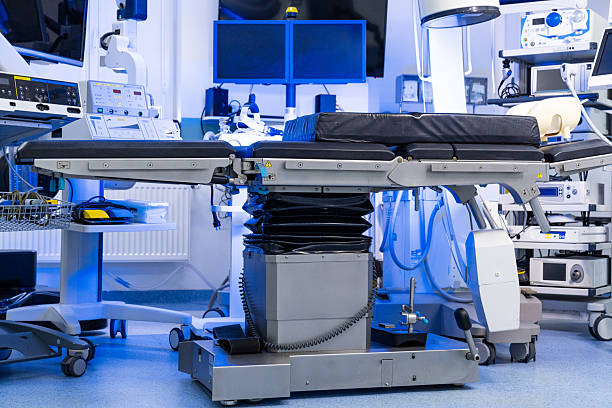
An operating table provides the foundation for positioning and adjusting the patient according to the requirements of each surgical procedure.
Depending on the device, the table may support:
- Height adjustment.
- Tilting in multiple directions.
- Adjustment of individual tabletop sections.
- Tabletop translation.
- Use of positioning accessories.
- Other specialty-specific configurations.
IEC 60601-2-46:2023 specifies particular requirements for the basic safety and essential performance of operating tables, including tables with or without electrical components and certain transport systems for detachable tabletops.
What Should Be Considered When Selecting an Operating Table?
The facility should not ask only:
“What is the maximum load capacity?”
It should also assess:
- Adjustment range.
- Load capacity across different configurations.
- Access to the surgical field.
- Compatibility with imaging equipment where required.
- Tabletop dimensions.
- Positioning accessories.
- Ease of attaching and removing accessories.
- Power supply and battery where applicable.
- Mobility and locking mechanisms.
- Cleaning procedures.
- Maintenance capability.
The stated maximum load should not automatically be interpreted as meaning that every table position or configuration supports the same load. The exact manufacturer documentation should be reviewed.
2. Surgical Lights
A surgical luminaire is not an ordinary lighting fixture.
IEC 60601-2-41:2021 applies to the basic safety and essential performance of surgical luminaires and luminaires for diagnosis, distinguishing them from general-purpose lighting.
The purpose of the system is to provide an appropriate illuminated field for clinical procedures while allowing positional adjustment within the operating room.
Factors to Evaluate
- Ability to adjust illuminance.
- Characteristics and size of the illuminated field.
- Ability to maintain illumination when obstructions are present.
- Range of positional adjustment.
- Stability of the suspension arm.
- Heat generation.
- Optical characteristics stated by the manufacturer.
- Handle design and cleaning method.
- Integrated camera where available.
- Replaceability of modules or light sources.
- Ceiling-structure requirements.
Two surgical lights should not be compared only by asking:
“How many lux?”
A single illuminance value does not fully represent real-world usability.
3. Anesthesia Workstations
An anaesthetic workstation is one of the most complex systems in the operating room.
ISO 80601-2-13:2022, now with Amendment 1:2026, specifies basic safety and essential performance requirements for anaesthetic workstations. Amendment 1:2026 was officially published by ISO on August 13, 2026.
Within the scope of the standard, an anaesthetic workstation may involve components such as:
- Anesthetic gas delivery system.
- Breathing system.
- Anesthetic gas scavenging system.
- Vapor-delivery system.
- Anesthesia ventilator.
- Monitoring equipment.
- Alarm systems.
- Protective devices.
This means the anesthesia system should not be evaluated as a single standalone device.
Key Areas to Clarify
- Required gas supplies.
- Connection to the medical gas system.
- Anesthesia ventilator.
- Vaporizer.
- Breathing system.
- Anesthetic gas scavenging system where applicable.
- Integrated monitor.
- Alarms.
- Power supply and backup battery.
- Accessories.
- Circuits and consumables.
- Cleaning methods.
- Maintenance requirements.
The specific configuration should be based on the surgical scope, system configuration, and professional requirements of the facility.
4. Patient Monitors in the Operating Room

Operating room monitors may track parameters such as:
- ECG/heart rate.
- SpO₂.
- Non-invasive blood pressure.
- Invasive blood pressure where required.
- Temperature.
- CO₂.
- Other parameters depending on the configuration.
An important point is that not every operating room requires the same monitor configuration.
The facility should determine:
- Which parameters need to be monitored?
- Will the monitor be standalone or part of the anesthesia system?
- Are expansion modules required?
- Does data need to be stored?
- Is integration with an anesthesia information system or HIS/EMR required?
- When the patient is transferred to the recovery area, how will monitoring data continuity be maintained?
Monitors should not be selected solely according to the number of advertised parameters.
5. Electrosurgical Units and Other Energy Systems
An electrosurgical unit (ESU) uses high-frequency electrical current to perform surgical functions in accordance with the intended use of the equipment and its accessories.
IEC 60601-2-2:2017 together with Amendment 1:2023 applies to the basic safety and essential performance of high-frequency surgical equipment and high-frequency surgical accessories. IEC currently publishes the consolidated version IEC 60601-2-2:2017+AMD1:2023.
Depending on the system, configurations may include:
- Monopolar.
- Bipolar.
- Cutting and coagulation modes.
- Other specialized energy technologies.
Maximum Power Should Not Be the Only Evaluation Criterion
Facilities should review:
- Energy modes.
- Compatible accessories.
- Electrodes.
- Footswitches or hand controls.
- Accessory-recognition capability where available.
- Neutral-electrode monitoring where applicable.
- Alarms.
- Cleaning.
- Maintenance.
- Cost of disposable or reusable consumables.
Higher power does not automatically mean the device is more suitable.
6. Suction and Surgical Smoke Management Systems
Operating rooms commonly require suction for several different purposes.
Suction may be provided by:
- Central vacuum systems.
- Standalone suction units.
- Dedicated suction systems.
Components may include:
- Collection canisters.
- Tubing.
- Filters.
- Suction tips.
- Dedicated surgical smoke evacuation systems where required.
7. Endoscopy and Minimally Invasive Surgery Systems
For endoscopic operating rooms, the equipment list may expand into a specialized imaging and instrument system.
A configuration may include:
- Camera.
- Camera control unit.
- Light source.
- Medical display.
- Endoscope.
- Insufflator where appropriate.
- Recording system.
- Pumps or other specialty equipment.
- Instrument sets.
- Trolley.
Not every component is mandatory for every specialty.
8. Infusion Equipment and Other Support Devices

Depending on the operating room type and specialty, additional equipment may include:
- Infusion pumps.
- Syringe pumps.
- Warming devices.
- Defibrillator.
- Emergency cart.
- Suction equipment.
- Specialty equipment.
- Intraoperative imaging equipment where applicable.
The specific list should be developed based on:
specialty + procedure type + complexity + facility capability + backup strategy.
An equipment list from one operating room should not be used as a mandatory template for all other rooms.
9. Operating Room Equipment Cannot Be Separated from Infrastructure
A device may be suitable in terms of functionality but still be impossible to deploy if the room does not meet its technical requirements.
10. Operating Room Layout Should Be Planned Around the Operating Envelope
The design should not simply add together the physical dimensions of each device.
It should also account for:
- Operating-table movement zone.
- Surgical-light arms.
- Pendants.
- Trolleys.
- Anesthesia system.
- Endoscopy tower.
- Staff working space.
- Patient transport routes.
- Cleaning space.
- Maintenance space.
It is useful to distinguish between:
equipment footprint
and:
the space required to operate, access, and maintain the equipment.
A room that “physically fits all the equipment” may still not function efficiently as an operating room.
11. Compatibility Is More Important Than the Number of Devices

An operating room contains many interfaces among systems:
- Monitor ↔ anesthesia system.
- Electrosurgical unit ↔ accessories.
- Endoscopy system ↔ display.
- Camera ↔ recording system.
- Equipment ↔ network.
- Equipment ↔ HIS/EMR.
- Imaging system ↔ PACS.
- Pendant ↔ electrical power/medical gases.
- Operating table ↔ intraoperative imaging equipment where applicable.
Hospitals should therefore develop a compatibility and connectivity matrix between systems before final configuration acceptance.
| System A | System B | What Should Be Confirmed? |
|---|---|---|
| Anesthesia workstation | Medical gases | Connectors, gas supply, technical requirements |
| Monitor | HIS/EMR | Protocol, gateway/middleware where required |
| Endoscopy system | Display | Signal, resolution, connectors |
| Endoscopy system | PACS/storage system | Ability to store/transfer data where applicable |
| Electrosurgical unit | Accessories | Type and compatibility |
| Light/table/pendant | Structure | Load, installation position, movement zone |
| Equipment | Electrical power | Power requirements, outlets, backup power |
Not every operating room requires all of the connections above.
12. Cleaning and Infection Control from an Equipment Perspective
Operating room equipment includes many frequently touched surfaces:
- Displays.
- Control buttons.
- Handles.
- Cables.
- Footswitches.
- Operating tables.
- Rails.
- Trolleys.
When selecting equipment, facilities should assess:
- Are the surfaces easy to clean?
- Are there many difficult-to-access gaps?
- Which cleaning agents are permitted by the manufacturer?
- Which components can be removed?
- Which consumables are reusable?
- Which are single-use?
- What reprocessing procedure does the manufacturer specify?
The same chemical should not automatically be assumed to be suitable for every device.
13. Maintenance and Operational Continuity
An operating room may depend on dozens of devices.
If one critical component becomes unavailable, the entire room may be affected.
Depending on the equipment, the maintenance program may include:
- Visual inspection.
- Functional testing.
- Electrical safety testing according to the facility's program.
- Battery checks.
- Alarm testing.
- Calibration or verification where appropriate.
- Mechanical-component inspection.
- Firmware/software updates.
- Replacement of wear components.
The specific interval should be based on manufacturer instructions, risk level, usage history, and the hospital's equipment-management program.
14. Total Cost Extends Beyond the Equipment Purchase Price
When comparing configurations, facilities should also calculate:
- Accessories.
- Consumables.
- Batteries.
- Cables.
- Trolleys.
- Pendants.
- Suspension systems.
- Software.
- Software licenses.
- Data connectivity.
- Maintenance.
- Calibration or verification where required.
- Spare parts.
- Training.
- Upgrades.
- Infrastructure renovation or site-preparation costs.
For example, an endoscopy system may have an acceptable equipment price but rely on multiple proprietary accessories and high-cost consumables, resulting in a lifecycle cost that differs substantially from the initial purchase price.
15. Ten Criteria for Selecting Operating Room Equipment
1. Fit with the Specialty and Room Type
Determine which surgical groups the room is expected to support rather than applying the same configuration to every operating room.
2. Intended Use of the Equipment
Review the intended use stated by the manufacturer.
3. Compatibility
Evaluate:
- Accessories.
- Cables and connectors.
- Medical gases.
- Other devices.
- Data systems.
4. Infrastructure Requirements
Review:
- Electrical power.
- Backup power.
- Medical gases.
- Suction.
- HVAC.
- Structural requirements.
- Network.
5. Usability
Demonstrations should be performed in conditions resembling actual use rather than evaluating each device only in isolation.
6. Cleaning and Consumables
Review:
- Surfaces.
- Compatible chemicals.
- Accessories.
- Reusable/single-use consumables.
7. Software and Data
For connected devices, clarify:
- HIS/EMR.
- PACS.
- Gateway/middleware.
- Cybersecurity.
- Software lifecycle.
8. Maintenance
Review maintenance requirements, test equipment, software updates, and calibration or verification where appropriate.
9. Technical Support
Evaluate:
- SLA.
- Engineers.
- Spare parts available in Vietnam.
- Repair time.
- Temporary replacement equipment.
10. Total Lifecycle Cost
Include:
- Equipment.
- Accessories.
- Consumables.
- Infrastructure.
- Software.
- Maintenance.
- Upgrades.
12 Questions to Ask Suppliers Before Shortlisting
1. Which operating room types and specialties is the equipment intended for according to its stated intended use?
2. Which accessories are included in the quoted configuration?
3. Are there any mandatory proprietary consumables or accessories?
4. What electrical power, medical gases, suction, network, or structural requirements does the equipment have?
5. Are there any special requirements for operating or maintenance clearance?
6. Which existing hospital systems can the equipment connect to?
7. Are additional gateways, middleware, or connectivity components required?
8. What are the cleaning procedures and compatible chemicals?
9. What test equipment, spare parts, or verification activities are required for maintenance?
10. How are spare parts and consumables supplied in Vietnam?
11. How are SLA coverage and temporary replacement equipment organized?
12. What is the total multi-year cost including equipment, accessories, consumables, infrastructure, and maintenance?
Short Checklist Before Investing in Operating Room Equipment

Needs and Infrastructure
- Specialty and surgical types are clearly defined.
- Core and optional equipment have been separated.
- Electrical power, medical gases, suction, and HVAC have been reviewed.
- Ceiling structure and network infrastructure have been coordinated.
- There is sufficient space for transport, operation, and maintenance.
Compatibility and Operations
- Table, lights, and pendants have been checked for movement-zone conflicts.
- The anesthesia system is compatible with the medical gas infrastructure.
- Monitor and data-system connectivity has been clarified.
- Endoscopy, displays, and image-storage systems have been checked for compatibility.
- Energy devices and accessories have been confirmed.
- Practical demonstrations have been completed.
Service and Cost
- Consumables/accessories have a reliable supply source.
- Warranty and SLA are clearly defined.
- Spare-parts supply has been planned.
- A contingency plan is available if critical equipment becomes unavailable.
- Total lifecycle cost has been calculated.
Frequently Asked Questions About Operating Room Equipment

What Equipment Is Commonly Found in an Operating Room?
Depending on the specialty and configuration, common equipment may include operating tables, surgical lights, anesthesia workstations, patient monitors, surgical energy systems, suction systems, endoscopy systems, infusion equipment, and other support devices.
Does Every Operating Room Need the Same Equipment List?
No. The equipment list depends on the specialty, types of surgery, facility size, and operating model.
Should Operating Tables and Surgical Lights Be Coordinated with the Building Structure During the Design Stage?
Yes, particularly for ceiling-mounted equipment. Position, structural load, and movement zones should be coordinated with architecture, HVAC, and other related technical systems.
Can Endoscopy Equipment from Different Manufacturers Be Used Together?
In some configurations, this may be possible, but it should not be assumed. Connectors, signals, accessories, data, and compatibility documentation should be reviewed.
Does Operating Room Equipment Need to Connect to HIS/EMR?
Not every device requires integration. When data exchange is needed, the hospital should define the integration objective, required connectivity components, cybersecurity requirements, and implementation responsibilities.
Should Hospitals Purchase Operating Room Equipment Based on the Lowest Price?
The purchase price should not be the only consideration. Accessories, consumables, infrastructure, maintenance, software, spare parts, and equipment downtime may significantly affect long-term costs.
This article is provided for informational purposes regarding equipment categories and technical considerations when investing in, planning, and operating an operating room. Equipment lists, professional configurations, and usage requirements should be determined according to the facility's scope of practice, manufacturer instructions, and applicable standards and regulations. The IEC/ISO standards mentioned are international technical references; the inclusion of a standard in this article does not mean that it automatically constitutes a mandatory legal requirement in Vietnam.
Evaluate the Operating Room as an Integrated System at PHARMEDI & HEALTHCARE VIETNAM 2026
When investing in an operating room, hospitals may easily approach the project device by device: first selecting the operating table, then the surgical lights, anesthesia workstation, monitor, energy devices, and endoscopy system. In actual operation, however, these systems all depend on space, electrical power, medical gases, ceiling-support structures, accessories, data, maintenance, and their ability to work together.
For this reason, investment planning is more complete when the operating room is viewed as an integrated equipment system rather than a collection of standalone devices.
At PHARMEDI & HEALTHCARE VIETNAM 2026, the Product Showcase Area announced by the Organizing Committee includes medical devices and supplies, alongside diagnostic technologies, digital health, and smart healthcare. For professional visitors, the area is positioned as an opportunity to explore solutions, compare technologies, and identify options that fit investment or upgrade plans.
For hospitals building, upgrading, or standardizing operating rooms, exploration at PHARMEDI VIETNAM 2026 can focus on:
- Do the operating table and accessories support the intended specialties?
- What structural requirements do surgical lights, pendants, and other ceiling-mounted equipment have?
- Which gas supplies and infrastructure are required by the anesthesia workstation?
- To what extent can the monitor, anesthesia system, and information systems exchange data?
- Which accessories are used by high-frequency surgical equipment, and what are the related consumable costs?
- Are the endoscopy system, displays, and image-storage systems compatible?
- How many electrical outlets, UPS systems, or network connections are required?
- Are cleaning and maintenance procedures suitable for the hospital's operating conditions?
- Are spare parts and consumables supplied reliably in Vietnam?
- If a critical device becomes unavailable, does the supplier provide support or temporary replacement equipment?
- How does total cost change when infrastructure, consumables, software, and maintenance are included?
The questions above are an evaluation framework suggested by this article, not a mandatory product list for the exhibition.
From Procurement Decisions to the Operating Capability of the Entire Operating Room
The perspective on operating room equipment can also be expanded through the International Conference Series on Investment and Innovation in Healthcare, taking place on September 22–23, 2026.
On Day 1 – September 22, the program includes the session “Hospital Supply Procurement & Investment Decisions: How Are Hospitals in Vietnam Approaching Them?”, scheduled from 11:30 AM–12:15 PM. The session is not announced as a program specifically dedicated to operating rooms, but for an area involving multiple devices and strong infrastructure dependencies, it provides additional context for facilities to consider how technical requirements are developed, how multiple parties coordinate, and how long-term investment value is assessed.
On Day 2 – September 23, the program shifts its focus to Hospital Management & Operations, including perspectives on the hospital of the future: smart, sustainable, and patient-centered.
For operating rooms, this is a natural continuation of the investment decision. A strong configuration requires more than having enough equipment; it should also help the hospital maintain stable workflows, coordination among systems, backup arrangements, and continuity when a device or infrastructure layer experiences an incident.
The question can therefore shift from:
“Which equipment does the operating room need?”
to:
“Can these devices operate together reliably within the same operating room?”
B2B Matchmaking – Review the Interfaces Between Multiple Systems
For operating room projects involving multiple suppliers, B2B Matchmaking at PHARMEDI provides additional opportunities for one-to-one connections with companies based on needs and potential fit.
Instead of discussing each device separately, hospitals can bring a layout, equipment list, or proposed requirements matrix to explore system interfaces in greater depth, such as:
- Do the operating table, surgical lights, and pendants create conflicts in their movement zones?
- Where does the anesthesia workstation require electrical power, medical gases, and suction?
- How should the monitor, anesthesia system, or endoscopy system exchange data?
- Do devices from different manufacturers require gateways, middleware, or adapter accessories?
- Who is responsible for verifying compatibility between systems?
- When a critical device requires maintenance, how will temporary replacement or room transfer be organized?
- Which items are the responsibility of the equipment supplier, hospital, or MEP contractor?
These questions are particularly important in operating rooms because a device may perform well when evaluated independently but may not necessarily fit when positioned beside other equipment within the same physical space and real-world workflow.
In this way, PHARMEDI & HEALTHCARE VIETNAM 2026 can serve as a reference point for hospitals not only when sourcing individual devices, but also when evaluating the level of integration among equipment, infrastructure, data, and the operating model of the entire operating room.
Dates: September 22–24, 2026
Venue: Saigon Exhibition and Convention Center (SECC), Ho Chi Minh City
Exhibitor Registration:https://pharmed.vn/exhibitor/application-form
Visitor Registration:https://ers-vn.informa-info.com/pha2026?cid=FB
Contact
Booth Booking: [email protected] (Thanh Thuý)
Media Support: [email protected] (Anita Pham)
Visitor Support: [email protected] (Ciel Le)
Related post
- PERFECT COMBINATION BETWEEN MANUFACTURING EQUIPMENT AND HIGH QUALITY HEALTH SERVICES FROM TAIWAN
- With double digit growth in the past few years, Việt Nam’s medical equipment and pharmaceutical markets are increasingly attractive to investors.
- VIETNAM: MOH releases new Decree on Medical Device Management - Decree 98/2021/NĐ-CP – November, 2021
- Tiny Robots Could Swim Through Your Blood to Prevent Strokes