


Pulmonary function testing equipment is used to record and analyze parameters related to airflow and air volume during breathing. This equipment category plays an important role in Respiratory Departments, pulmonary function laboratories, and healthcare facilities that need to assess lung function.
In practice, one of the most common devices in this category is the spirometer, which can record parameters such as FVC, FEV₁, the FEV₁/FVC ratio, and peak expiratory flow (PEF).
This article explains the operating principles, measurement technologies, common parameters, and selection criteria for pulmonary function testing equipment used in hospitals and clinics.
What Is Pulmonary Function Testing Equipment?
Pulmonary function testing (PFT) equipment refers to a group of devices used to assess physiological characteristics of the respiratory system through specialized measurements.
Among these devices, a spirometer is commonly used to measure airflow and the volume of inhaled or exhaled air according to its designed measurement method.
- Conventional spirometry.
- Recording of airflow and air volume.
- Display of flow–volume curves.
- Display of volume–time curves.
- Assessment of measurement quality.
- Comparison of results against reference values.
- Storage and export of reports.
- Additional pulmonary function measurements when appropriately equipped.
According to the American Thoracic Society (ATS) and European Respiratory Society (ERS), spirometry is one of the most widely used pulmonary function testing methods and requires a combination of equipment that meets performance requirements, standardized procedures, and competent personnel.
Is Pulmonary Function Testing Equipment the Same as a Ventilator?
Pulmonary function testing equipment is used to record parameters that support the assessment of respiratory function.
In contrast, a medical ventilator is designed to support or control a patient's ventilation according to professional indications.
| Criterion | Pulmonary Function Testing Equipment | Medical Ventilator |
|---|---|---|
| Purpose | Measures and assesses respiratory function | Supports or controls ventilation |
| Operating principle | Records airflow, air volume, and related parameters | Generates and controls respiratory gas flow |
| Common parameters | FVC, FEV₁, FEV₁/FVC, PEF | Pressure, gas volume, FiO₂, PEEP, and other ventilation parameters |
| Use environment | Pulmonary function laboratories, clinics, and Respiratory Departments | ICUs, Emergency Departments, and respiratory-support areas |
| Operational requirements | Measurement quality, sensors, software, and trained technicians | Ventilation-control system, alarms, and gas supply |
1. Operating Principle of Pulmonary Function Testing Equipment
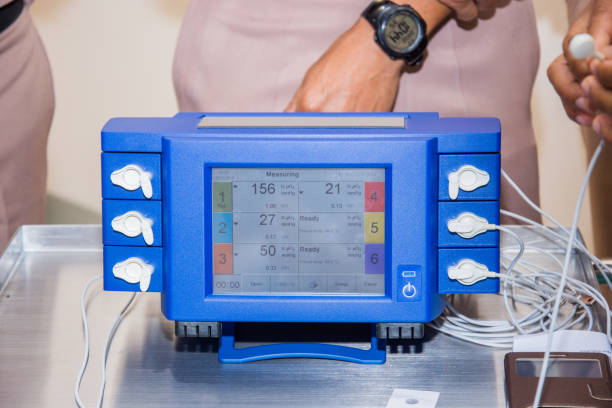
The operating principle of a spirometer is based on measuring changes in airflow or air volume during breathing.
Airflow Measurement
- Differential-pressure sensors.
- Turbine sensors.
- Ultrasonic sensors.
- Thermal sensors.
- Other measurement principles.
The sensor signals are converted into electronic data and processed by software.
Air Volume Calculation
For flow-measuring systems, volume can be calculated by integrating airflow over time.
V(t) = ∫₀ᵗ Q(τ) dτ
- V(t): accumulated air volume up to time t.
- Q: airflow.
- t: time.
Result accuracy depends on the sensor, digitization process, calibration, environmental conditions, and processing algorithm.
Result Display
- Generate flow–volume curves.
- Generate volume–time curves.
- Calculate spirometry parameters.
- Check measurement-quality criteria.
- Store results.
- Generate reports.
Result reliability should be evaluated based on measurement performance and the quality-control capability of the complete system.
2. Sensor Technologies Used in Pulmonary Function Testing Equipment
Sensor technology is one of the important technical factors when selecting a spirometer.
Differential-Pressure Sensor (Pneumotachograph)
A pneumotachograph measures airflow based on pressure changes as gas passes through a component with known flow-resistance characteristics.
The system measures the pressure difference and uses the relationship between pressure and flow to calculate the data.
- Fleisch pneumotachograph.
- Lilly pneumotachograph.
- Other differential-pressure sensors using flow-resistance structures.
Turbine Sensor
A turbine spirometer uses a rotating mechanism driven by airflow.
The system records rotational speed or the number of revolutions and converts this information into airflow or volume data according to its design.
Ultrasonic Sensor
Some systems analyze differences in ultrasound transit time in directions related to airflow.
An ultrasonic spirometer uses ultrasound waves to assess airflow through the measurement region.
This technology can be designed without rotating mechanical components in the measurement pathway.
Thermal Sensor
Some devices use measurement principles based on changes in heat transfer as gas flows past a sensing element.
Measurement capability depends on the design, gas characteristics, and environmental factors.
Comparison of Sensor Technologies
| Technology | Measurement Principle | What Should Be Evaluated? |
|---|---|---|
| Pneumotachograph | Measures pressure differences related to airflow | Accuracy, humidity, cleaning, and calibration verification |
| Turbine | Records the movement of a rotating mechanism | Mechanical characteristics, stability, and maintenance |
| Ultrasonic | Analyzes ultrasound signals affected by airflow | Accuracy, stability, and test conditions |
| Thermal sensor | Uses changes in heat transfer caused by airflow | Sensitivity, environmental conditions, and gas characteristics |
A study evaluating the performance of different spirometer types, published in 2022, showed that devices using different technologies may vary in accuracy and measurement characteristics.
Therefore, sensor technology is only one selection criterion. Facilities should request performance evidence and review the quality-control procedures for the exact model being considered.
3. Common Categories of Pulmonary Function Testing Equipment
In the market, the term pulmonary function testing equipment may refer to several device types.
Handheld Spirometer
A handheld spirometer generally has a compact design that allows convenient transport and use in appropriate locations.
- FVC measurement.
- FEV₁ measurement.
- Calculation of the FEV₁/FVC ratio.
- PEF measurement.
- Curve display.
- Result storage.
- Connectivity with a computer or software.
Computer-Based Spirometer
This equipment category uses a sensor connected to a computer or compatible control device.
- Real-time curve display.
- Patient-information management.
- Measurement-quality assessment.
- Comparison of measurements.
- Report generation.
- Data export.
- Connectivity with the facility's information systems.
Advanced Pulmonary Function Testing System
- Measurement of static lung volumes.
- Measurement of pulmonary gas-transfer capacity.
- Measurement of airway resistance.
- Other advanced pulmonary function tests.
For example, equipment that measures lung volumes through body plethysmography uses a dedicated measurement chamber.
Meanwhile, DLCO measurement requires specific components and measurement methods related to gas-transfer capacity.
Comparison of Spirometry and Advanced PFT Systems
| Criterion | Spirometer | Advanced PFT System |
|---|---|---|
| Primary function | Measures airflow and volume using spirometry | May integrate multiple pulmonary function measurements |
| Common parameters | FVC, FEV₁, FEV₁/FVC, PEF | Spirometry parameters and additional measurements |
| TLC and RV | Not directly measured by conventional spirometry alone | May be supported with appropriate modules |
| DLCO | Not a standard function of a standalone spirometer | May be supported with dedicated equipment |
| Infrastructure | Generally relatively simple | Depends on the number of modules and technologies |
| Cost | Depends on sensor and software configuration | Additional modules, test gases, accessories, and maintenance must be considered |
For hospitals preparing procurement lists, this distinction helps avoid purchasing equipment with insufficient functionality or investing in a system that exceeds actual requirements.
4. Common Parameters Measured by Spirometers
Spirometry parameters reflect different aspects of airflow and air volume.
| Parameter | Full Name | Basic Technical Meaning |
|---|---|---|
| FVC | Forced Vital Capacity | Volume of air exhaled during a forced expiratory maneuver |
| FEV₁ | Forced Expiratory Volume in 1 Second | Volume of air forcibly exhaled during the first second |
| FEV₁/FVC | Ratio of FEV₁ to FVC | Ratio between FEV₁ and FVC |
| PEF | Peak Expiratory Flow | Highest expiratory flow recorded during a forced expiration |
| FEF₂₅–₇₅ | Forced Expiratory Flow Between 25% and 75% of FVC | Mean expiratory flow over the corresponding volume interval |
| VC | Vital Capacity | Vital capacity when measured using an appropriate method |
| FET | Forced Expiratory Time | Recorded duration of the forced expiratory maneuver |
FVC – Forced Vital Capacity
FVC represents the volume of air exhaled during a forced expiratory maneuver performed using a standardized method.
Results may be affected by technique, signal quality, and other related factors.
FEV₁ – Forced Expiratory Volume in One Second
FEV₁ represents the volume of air exhaled during the first second of a forced expiratory maneuver.
This parameter is commonly used together with FVC and other indicators.
FEV₁/FVC Ratio
FEV₁/FVC is the ratio between the volume exhaled during the first second and forced vital capacity.
However, results should be evaluated using appropriate reference values and interpretation criteria rather than relying solely on one fixed threshold for every patient.
PEF – Peak Expiratory Flow
PEF is the highest airflow value recorded during a forced expiratory maneuver.
This parameter may be included in a spirometer or measured using other dedicated devices.
A simple PEF meter should be distinguished from a spirometry system capable of recording complete curves and spirometry parameters.
FEF₂₅–₇₅
FEF₂₅–₇₅ describes the mean expiratory flow over the interval between 25% and 75% of FVC.
This parameter may be calculated by software, but it is affected by multiple factors and should not be used independently to establish a diagnosis.
Flow–Volume and Volume–Time Curves
Flow–Volume Curve: shows the relationship between airflow and volume during measurement.
Volume–Time Curve: shows how air volume changes over time.
These graphs help qualified personnel review measurement quality, technical characteristics, and relevant data requiring assessment.
5. Why Is Quality Control Particularly Important in Spirometry?
- Testing technique.
- Level of patient cooperation.
- Airtightness of the system.
- Sensor quality.
- Signal interference.
- Environmental conditions.
- Processing software.
- Competence of the personnel evaluating the results.
ATS/ERS 2019 Standardization Guidance
The Standardization of Spirometry 2019 Update, published by the ATS and ERS, provides technical and practical requirements relating to:
- Equipment performance.
- Calibration verification.
- Quality management.
- Measurement acceptability criteria.
- Repeatability.
- Quality assessment and grading.
- Result display and reporting.
- Competence of testing personnel.
Measurement Acceptability
Acceptability refers to whether a measurement meets established quality requirements.
- An inadequate start of the maneuver.
- Interference or abnormalities during recording.
- An end-of-test condition that does not meet the required criteria.
- Other technical indicators.
Measurement Repeatability
According to ATS/ERS 2019, for patients older than six years, high-quality repeatability criteria generally require the difference between the two largest FEV₁ values and the difference between the two largest FVC values to be no greater than 0.150 liters, subject to the associated acceptability conditions.
Other age groups and quality grades have their own criteria.
Quality Grading from A to F
ATS/ERS 2019 provides a spirometry quality-grading system comprising grades A, B, C, D, E, U, and F.
FEV₁ and FVC quality are assessed separately based on the number of acceptable measurements and their repeatability.
- Does the software support quality grading?
- Does it display technical alerts?
- Are the original curves stored?
- Can personnel review and assess the data?
- Does the report indicate result quality?
6. Calibration and Accuracy Verification of Spirometers
It is necessary to distinguish between calibration and calibration verification.
What Is Calibration?
Calibration establishes the relationship between a sensor signal and the corresponding airflow or volume value.
Some devices allow calibration to be performed by the operator. Other models are factory-calibrated and do not allow users to modify calibration coefficients.
What Is Calibration Verification?
Calibration verification checks whether the equipment continues to meet the required accuracy limits.
According to ATS/ERS 2019, spirometry equipment should undergo daily calibration verification, or more frequently if specified by the manufacturer.
For standardized ATS/ERS procedures, verification commonly uses a 3-liter calibration syringe (3-L calibration syringe) and includes testing at multiple flow rates.
If verification results are outside the acceptable limits, facilities should take appropriate technical action according to manufacturer instructions before continuing to use the equipment.
Factors That May Affect Verification Results
- Dirty or obstructed sensors.
- Air leaks at connectors.
- Incorrectly installed accessories.
- Changes in environmental conditions.
- Calibration-syringe faults.
- Data-entry errors.
- Damage to or changes in sensor characteristics.
If the system uses a filter during measurement, the verification configuration should follow the technical instructions and applicable standard requirements.
What Is the Role of BTPS?
BTPS (Body Temperature, Ambient Pressure, Saturated) refers to standardized conditions used when expressing gas-volume measurements related to respiratory function.
- Does the equipment support BTPS correction?
- Must ambient temperature or pressure be entered manually?
- Does the system include environmental sensors?
- What accuracy-verification procedure does the manufacturer specify?
ISO 26782 Standard
ISO 26782:2009 – Anaesthetic and respiratory equipment — Spirometers intended for the measurement of time forced expired volumes in humans specifies requirements for spirometers used to measure forced expiratory volumes over time.
As of October 2026, ISO 26782:2009 remains the published edition, while a replacement version is under development.
International standards are technical references. Whether their application is mandatory in Vietnam depends on current regulations and the requirements applicable to each situation.
7. Analysis Software and Reference Values
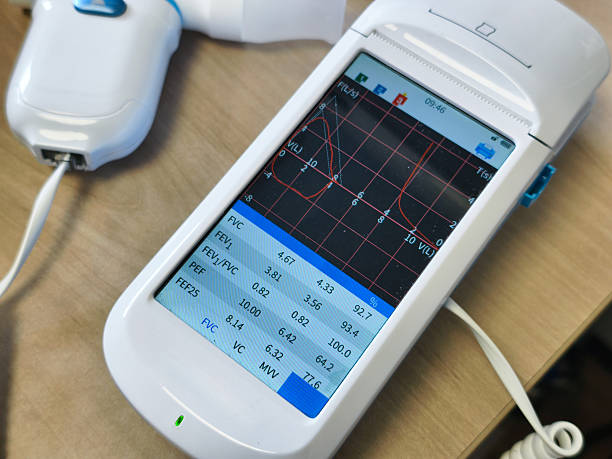
Spirometry software does more than display curves.
Reference Values in Spirometry
The Global Lung Function Initiative (GLI) provides reference equations for spirometry and certain other pulmonary function measurements.
Spirometry results are commonly compared with reference values developed from population data.
- Age.
- Height.
- Biological sex as used in the calculation equation.
- Other factors required by the specific equation.
Why Should Reference-Equation Software Be Evaluated?
- Which reference equations does the software use?
- Does it display the source and version?
- Does it support the lower limit of normal (LLN) and z-scores?
- Can the original measurement data be exported?
- Do reference equations change when the software is updated?
- Can results be compared consistently over time?
According to ERS/ATS 2022 guidance, interpretation of pulmonary function tests should consider data quality, reference equations, statistical limits, and clinical information.
Can the Software Automatically Diagnose Disease?
Some systems provide classification functions or suggested interpretations.
Measurement accuracy, technical quality of the test, and clinical interpretation are three distinct considerations.
8. Personnel and Operational Requirements
Pulmonary function testing equipment depends heavily on the quality of the measurement procedure.
Personnel Requirements
- Equipment principles.
- Intended-use scope.
- Measurement-quality criteria.
- Recognition of technical errors.
- Software operation.
- Calibration verification.
- Infection control.
- Data and record management.
According to the ATS/ERS, operator competence plays an important role in generating reliable spirometry data.
Testing Room Requirements
- Space for equipment placement.
- Appropriate tables and chairs.
- Computer location.
- Temperature and ventilation conditions.
- Hand-hygiene facilities.
- Consumable-storage areas.
- Surface-cleaning procedures.
- Arrangements for assistance if an abnormal situation occurs.
In addition, facilities should have procedures for assessing the patient's condition before testing, according to professional requirements.
9. Infection Control and Consumables
During spirometry, the patient comes into contact with a mouthpiece and the airflow-acquisition system.
Common Consumables
- Mouthpieces.
- Bacterial and viral filters.
- Nose clips.
- Single-use flow sensors.
- Connecting tubing.
- Reusable accessories permitted by the manufacturer.
Not all spirometers use the same type of filter or sensor.
Bacterial and Viral Filters
Some systems use dedicated filters to help reduce the risk of contamination of the sensor and airflow pathway.
- Is the filter approved for use by the equipment manufacturer?
- How is filtration performance specified?
- Does the filter affect airflow resistance?
- Does the equipment require adjustment or verification when the filter is used?
- Is the filter single-use or approved for reuse?
Equipment Cleaning and Disinfection
According to ATS/ERS 2019, infection control in pulmonary function laboratories includes activities such as hand hygiene, management of single-use supplies, and equipment cleaning according to instructions.
- Cleaning instructions.
- A list of compatible chemicals.
- Reprocessing procedures for approved reusable components.
- A list of single-use consumables.
- Storage and replacement requirements.
10. Data Storage and Hospital System Connectivity
- Storage of measurement results.
- Storage of original curves.
- PDF report generation.
- Patient-information management.
- Comparison of results over time.
- Data export.
- Connectivity with healthcare information systems.
- User-access permissions.
HIS/EMR Connectivity
- Does the device use standalone software or a centralized platform?
- Which parameters and formats can be exported?
- Are the original curves stored?
- Does the system support HL7, integration interfaces, or other connectivity methods?
- Are additional licenses required?
- How are data backed up?
- Does the software support access permissions and activity logs?
The presence of USB, Bluetooth, or network connectivity does not mean that the equipment can integrate directly with every hospital software system.
Why Should Original Curves Be Stored?
Flow–volume and volume–time curves may provide useful information when assessing measurement quality.
Therefore, facilities requiring long-term monitoring or retrospective result review should prioritize systems with appropriate data-storage and retrieval capability.
11. Ten Criteria for Selecting Pulmonary Function Testing Equipment for a Healthcare Facility
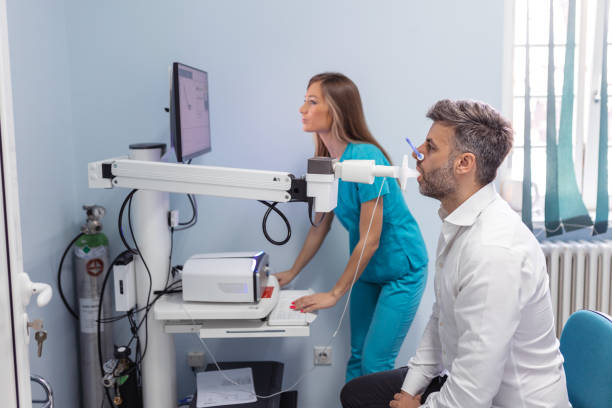
Hospitals and clinics may use the following criteria when comparing systems:
| Criterion | What Should Be Evaluated? |
|---|---|
| 1. Functional scope | Basic spirometry or an integrated PFT system |
| 2. Sensor technology | Pneumotachograph, turbine, ultrasonic, or another technology |
| 3. Measurement accuracy | Flow and volume performance and verification methods |
| 4. Supported parameters | FVC, FEV₁, FEV₁/FVC, PEF, and other required parameters |
| 5. Quality control | Calibration verification, acceptability assessment, and repeatability |
| 6. Software | Curves, reference equations, and quality grading |
| 7. Accessories and infection control | Mouthpieces, filters, sensors, and cleaning procedures |
| 8. Storage and connectivity | Data management, report export, and HIS/EMR integration |
| 9. Technical service | Training, testing, maintenance, and spare-parts supply |
| 10. Lifecycle cost | Equipment price, sensors, consumables, software, and maintenance |
Common Selection Mistakes
Confusing a spirometer with a comprehensive PFT system: Purchasing a spirometer while expecting it to measure TLC or DLCO directly.
Overlooking calibration verification: Assuming that factory-calibrated equipment will always maintain its accuracy.
12. Questions to Ask Suppliers Before Investment
1. Is the equipment a standalone spirometer or an integrated PFT system supporting multiple measurements?
2. Which sensor technology does the device use, and which standards are used to verify its performance?
3. Does the equipment support FVC, FEV₁, FEV₁/FVC, PEF, and the corresponding curves?
4. How does the system support calibration verification, and which accessories are required?
5. Does the software support acceptability assessment, repeatability, and quality grading?
6. Which reference equations are integrated, and can they be updated?
7. What use, cleaning, and replacement requirements apply to mouthpieces, filters, and sensors?
8. Can the equipment store curves, export reports, and integrate with HIS/EMR?
9. Does the supplier provide staff training, quality testing, and maintenance support in Vietnam?
10. How is the total multi-year cost of ownership, including consumables, software, and technical services, determined?
Frequently Asked Questions About Pulmonary Function Testing Equipment
What Is Pulmonary Function Testing Equipment?
It is a category of equipment used to record characteristics related to respiratory function. Among these devices, spirometers are commonly used to measure airflow and air volume using standardized methods.
Are Spirometers and Pulmonary Function Testing Systems the Same?
A spirometer is one type of pulmonary function testing equipment. However, advanced PFT systems may integrate additional measurements that conventional spirometers do not support.
Can Pulmonary Function Testing Equipment Measure FEV₁ and FVC?
Diagnostic spirometers commonly support FEV₁, FVC, and related parameters. The functional scope of each model should be confirmed.
Can a Spirometer Directly Measure TLC and RV?
No. Conventional spirometry does not directly measure total lung capacity (TLC) or residual volume (RV). These measurements require appropriate methods and equipment.
Does Pulmonary Function Testing Equipment Require Calibration?
Accuracy control is required. According to ATS/ERS 2019, spirometry equipment should undergo daily calibration verification using an appropriate method, including devices that are factory-calibrated.
Does a Spirometer Require Bacterial and Viral Filters?
Filter use depends on the device design, manufacturer instructions, and the facility's infection-control procedures. Filters must be compatible with the measurement system.
Can Pulmonary Function Testing Equipment Connect to HIS/EMR?
Some devices support data export or connectivity with healthcare information systems. Integration capability should be confirmed according to the specific software, protocols, and configuration.
Should a Clinic Choose a Handheld Spirometer or a Dedicated System?
The choice depends on professional scope, testing volume, data-management requirements, quality-control capability, and budget. Selection should not be based solely on equipment size or purchase price.
Explore Pulmonary Function Testing Equipment and Lung Function Assessment Solutions at Pharmedi Vietnam 2027
Pharmedi Vietnam 2027, taking place from September 28–30, 2027 at the Saigon Exhibition and Convention Center (SECC), Ho Chi Minh City, provides an opportunity for businesses, professionals, and healthcare organizations to meet, explore technologies, and discuss equipment solutions that support healthcare delivery.
For facilities preparing to invest in or upgrade pulmonary function laboratories, Pharmedi Vietnam 2027 provides an opportunity to explore equipment technologies, assess supplier capabilities, and prepare technical requirements before selecting an appropriate system.
Relevant solution groups include spirometers, advanced pulmonary function testing systems, flow sensors, analysis software, and respiratory data-management solutions.
- Which sensor technology does the device use, and which standards are used to evaluate accuracy?
- Which spirometry parameters and pulmonary function testing methods does the system support?
- Does the software support measurement-quality assessment, curve storage, and result comparison?
- How are calibration verification and the required accessories managed?
- How are mouthpieces, sensors, and filters supplied?
- Can the device connect to HIS/EMR and the facility's data-management systems?
- Does the supplier provide training, maintenance, and long-term technical testing support?
Dates: September 28–30, 2027
Venue: Saigon Exhibition and Convention Center (SECC), Ho Chi Minh City
Exhibition Information: https://pharmed.vn/
Product Categories: https://pharmed.vn/exhibitors/products
Visitor-registration information, participating-company lists, and activity programs will be updated according to official announcements from the Pharmedi Vietnam 2027 Organizing Committee.
This article is provided for informational purposes regarding the operating principles, technologies, and selection criteria for pulmonary function testing equipment. It does not provide instructions for performing tests on individual patients, prescribing medications, establishing treatment protocols, or interpreting results for diagnosis. Testing and result evaluation should be performed by appropriately qualified personnel in accordance with applicable standards, manufacturer instructions, and facility procedures.
Related post
- Thêm 30 triệu chiếc khẩu trang y tế xuất đi Bắc Mỹ
- EXPLORE THE THREE-DAY INTERNATIONAL CONFERENCE SERIES AGENDA AT PHARMEDI & HEALTHCARE VIETNAM 2026
- ENHANCING GRASSROOTS HEALTHCARE SYSTEMS
- What Is the Difference Between Medical Equipment Verification and Calibration? Key Considerations for Healthcare Facilities
- BUSINESS MATCHING INVITATION WITH CHINA ENTERPRISES