


Medical suction equipment generates negative pressure to help remove fluids, secretions, blood, and other liquids from areas where suction is required during patient care and treatment. These devices are used in operating rooms, Emergency Departments, Intensive Care Units (ICUs), and other clinical settings.
Today's medical suction equipment is available in a variety of configurations, ranging from compact electric suction units and battery-powered devices to surgical suction systems with large-capacity collection canisters. Some systems have integrated vacuum pumps, while others use the hospital's central medical vacuum supply.
However, selecting medical suction equipment involves more than comparing motor power or collection-canister capacity. Healthcare facilities should also evaluate vacuum performance, suction flow rate, overflow protection, protective filters, mobility, infection-control requirements, and maintenance capability.
In particular, a higher maximum vacuum level does not necessarily make a device suitable for every application. Each equipment category should be selected according to the manufacturer's stated intended use and the facility's clinical requirements.
This article explains operating principles, equipment categories, important technical specifications, and selection criteria for medical suction equipment used in hospitals and clinics in Vietnam.
What Is Medical Suction Equipment?
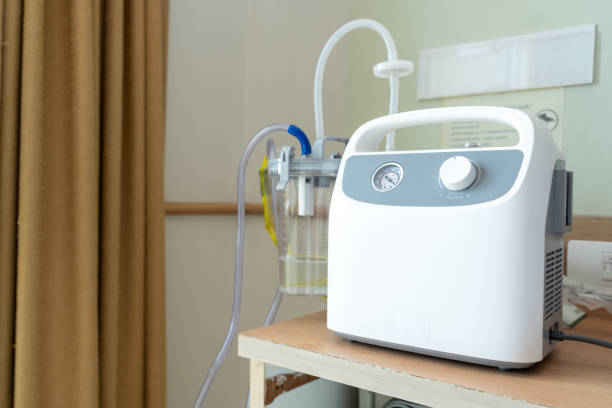
Medical suction equipment refers to devices that generate or use negative pressure to aspirate and collect fluids or secretions through compatible tubing and collection containers.
Depending on the design, a device may use:
- Alternating-current (AC) power.
- Rechargeable batteries.
- Direct-current (DC) power.
- Hand-operated or foot-operated suction mechanisms.
- A central medical vacuum supply.
- Pressurized gas to generate suction through the Venturi principle.
A suction system commonly includes a vacuum source, vacuum regulator, pressure gauge or display, suction tubing, collection canister, and protective components.
Under ISO 10079-1:2022, electrically powered medical suction equipment is subject to specific safety and performance requirements for healthcare settings, including hospitals, home healthcare, and transport environments within the device's intended scope.
Where Is Medical Suction Equipment Used?
Depending on its configuration and clinical intended use, the equipment may be used in:
- Operating rooms: To assist in the removal of blood and fluids from the surgical field using appropriate accessories.
- Emergency Departments: To provide suction for necessary emergency care procedures.
- Intensive Care Units: To support patient-care activities requiring suction.
- Inpatient wards: To meet indicated patient-care needs.
- Ambulances: Using compact devices capable of operating during transport.
- Home healthcare: Using devices authorized for this setting by the manufacturer and under the guidance of healthcare professionals.
Not every suction device is designed for all these environments.
For example, a surgical suction unit may have different requirements from a handheld suction device intended for transport.
1. Operating Principle of Medical Suction Equipment
The basic principle of a suction device is to create a pressure differential between the suction system and the environment at the suction site.
When pressure within the suction pathway is lower than pressure at the point of contact, air and fluids can move through the tubing into a collection container.
The basic flow path can be illustrated as follows:
Suction tip → Suction tubing → Collection canister → Overflow protection and protective filter → Vacuum source
This diagram illustrates only the general principle. Actual component positions and configurations depend on the design of each model.
Generating Negative Pressure
In electric suction devices, a vacuum pump uses electrical energy to create the pressure differential.
Possible pump technologies include:
- Diaphragm pumps.
- Piston pumps.
- Other vacuum pump designs.
Vacuum generation depends on pump design, motor performance, system airtightness, and operating conditions.
Adjusting the Suction Level
Many devices include a control that allows negative pressure to be adjusted within the range specified by the manufacturer.
The control may be:
- A mechanical rotary knob.
- An electronic controller.
- A regulator connected to the central medical vacuum system.
Some units also include a gauge or display showing the vacuum level.
Accurate and stable adjustment is an important evaluation criterion, particularly when a device is intended for several applications with different requirements.
Collecting Aspirated Fluids
Fluids are drawn through suction tubing into a collection canister.
The canister system generally requires a mechanism to help prevent liquids from entering the vacuum source.
Some devices use a float-type overflow shutoff valve, a filter, or other protective measures.
Protecting the Vacuum Source
If liquids or contaminants enter the pump, they may damage the device or contaminate the system.
Overflow protection and protective filters therefore play an important role.
However, a filter does not eliminate the need to manage, replace, and dispose of collection containers according to manufacturer instructions.
2. Main Components of Medical Suction Equipment
A suction system may include the following components:
| Component | Primary Function |
|---|---|
| Vacuum pump | Generates negative pressure in a standalone suction device |
| Motor | Supplies power to the pump |
| Vacuum regulator | Controls the negative pressure level |
| Gauge or display | Shows operating parameters |
| Fluid collection canister | Collects aspirated fluids |
| Tubing | Connects system components |
| Overflow valve or mechanism | Helps prevent liquid from overflowing beyond the canister |
| Protective filter | Helps prevent contaminants from entering the vacuum source |
| Power supply or battery | Provides energy according to the configuration |
| Control panel | Supports equipment operation and monitoring |
Vacuum Pump
The pump is an essential component of electrically powered suction devices with an integrated vacuum source.
When evaluating the pump, consider:
- Maximum vacuum level.
- Ability to maintain suction.
- Flow rate.
- Noise level.
- Operating load.
- Power consumption.
- Maintenance requirements.
A pump should not be evaluated solely by its electrical power rating in watts.
Two pumps with similar electrical ratings may differ in pressure, flow rate, and operating efficiency.
Vacuum Regulator and Pressure Gauge
The regulator enables operators to control suction within the device's permitted range.
The vacuum gauge may use units such as:
- kPa.
- mmHg.
- Other units depending on the device.
During procurement, facilities should evaluate scale readability, accuracy, adjustment capability, and technical verification documentation.
Fluid Collection Canister
The canister receives fluid collected during suction.
It may be manufactured from reusable material or designed for use with a disposable collection liner.
Canister capacity should match actual collection needs and the manufacturer's stated operating limits.
Protective Filters and Overflow Prevention
Depending on the design, a protective filter helps prevent contaminants from reaching components on the vacuum-source side.
Overflow protection helps stop liquid from moving toward protected components when a canister reaches its fill limit or an abnormal condition occurs.
System safety should be evaluated across the complete configuration rather than simply confirming that a canister or filter is present.
3. Types of Medical Suction Equipment by Vacuum Source
Medical suction devices can be classified in several ways. Classification by the source of negative pressure helps clarify operating principles and requirements.
Electrically Powered Suction Equipment
Electrically powered suction equipment uses an electric motor and pump to generate a vacuum.
Devices may be designed for:
- Operating rooms.
- Emergency Departments.
- ICUs.
- Procedure rooms.
- Other environments within the stated intended use.
Some models operate on mains electricity, while others may also include a backup battery.
Key specifications include vacuum level, flow rate, canister capacity, noise, and operational continuity.
Battery-Powered Suction Equipment
Battery-powered devices generally emphasize mobility.
Possible features include:
- An integrated or removable rechargeable battery.
- Operation without mains electricity.
- A carrying handle.
- Compact housing.
- Battery-level alarms.
- A compatible charger or power supply.
Such devices may be considered for emergency care, ambulances, or settings requiring frequent movement.
However, actual battery runtime depends on the level of use and test conditions.
Hand-Operated or Foot-Operated Suction Equipment
Manually powered suction equipment uses force applied by the operator to generate negative pressure.
ISO 10079-2:2022 covers this category of hand-operated or foot-operated devices designed for oropharyngeal suction, particularly in transport or out-of-facility settings within the stated scope.
One advantage is that no electrical supply is required to generate suction.
However, performance depends on the device mechanism and the operator's actions.
Manual suction devices should not be assumed to replace electrically powered surgical suction equipment in every application.
Equipment Using a Central Medical Vacuum Supply
Some suction devices do not have their own vacuum pump and instead receive suction from the hospital's central medical vacuum system.
A typical point-of-use configuration includes:
- A vacuum terminal connection.
- A vacuum regulator.
- A gauge or display.
- A collection canister.
- Suction tubing.
- Suitable protective components.
This arrangement differs from a standalone electrically powered suction device.
If the central vacuum supply fails, equipment dependent on that supply may be affected.
Venturi-Driven Suction Equipment
Some devices use compressed or pressurized gas to generate negative pressure through the Venturi effect.
This method is addressed in ISO 10079-3:2022, along with equipment that uses an external vacuum source.
When selecting such devices, facilities should confirm the gas supply type, consumption, compatibility, and safety requirements.
Comparison of Medical Suction Equipment Categories
| Equipment Type | Suction Source | What Should Be Evaluated? |
|---|---|---|
| Electrically powered suction device | Electrically driven pump | Vacuum, flow rate, noise, and maintenance |
| Battery-powered suction device | Electric pump and battery | Battery runtime, mobility, and charging |
| Manually powered suction device | Hand or foot power | Intended use, performance, and durability |
| Central vacuum suction equipment | Hospital medical vacuum network | Connector compatibility, regulation, and protection |
| Venturi suction equipment | Pressurized gas supply | Gas compatibility and suction-generation efficiency |
These categories are defined by their energy or suction sources and do not directly indicate suitability for a particular clinical procedure.
4. How Do Surgical and Emergency Suction Devices Differ?
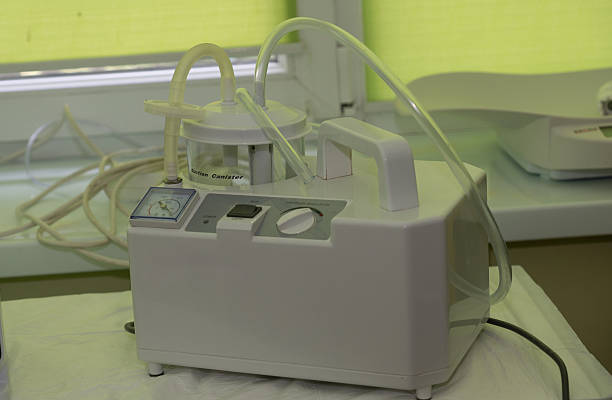
In addition to classification by suction source, medical suction equipment may be grouped by its intended environment and application.
Surgical Suction Equipment
Surgical suction apparatus is designed to assist in collecting blood and fluids during appropriate surgical procedures.
Depending on the model, features may include:
- A pump capable of continuous operation.
- Adjustable suction.
- Large-capacity collection canisters.
- A single- or dual-canister system.
- A mobile trolley.
- A foot-operated control.
- Overflow protection.
- Protective filtration.
When evaluating a system, facilities should consider its ability to maintain negative pressure, flow rate, and the convenience of replacing canisters or liners.
Conventional surgical suction equipment should not automatically be considered suitable for specialized systems such as intraoperative blood salvage or controlled chest drainage.
These applications have their own equipment requirements and defined intended uses.
Emergency Suction Equipment
Emergency suction devices generally emphasize readiness, portability, and operation under different conditions.
Depending on the design, features may include:
- Compact dimensions.
- A carrying handle.
- An integrated battery.
- Status-check functions.
- An easily readable display or gauge.
- Easily replaceable accessories.
When selecting a device, facilities should verify battery runtime, charging capability, and conditions of use during transport.
For example, the Laerdal Suction Unit (LSU) is a portable suction device with battery power, status-check functions, and several collection-canister options. According to the manufacturer, its battery runtime is approximately 45 minutes under free-air-flow test conditions.
This is an illustrative specification for one particular model, not a standard battery-runtime requirement for all emergency suction devices.
Suction Equipment Used in ICUs
In an ICU, a facility may use electrically powered suction equipment or regulators connected to a central vacuum supply.
Important evaluation factors include:
- Operational readiness.
- Stability of the suction level.
- Adjustment functions.
- Collection canisters.
- Ease of accessory replacement.
- Infection-control procedures.
- Contingency arrangements in the event of supply failure.
Depending on the application, patient-contact accessories must be selected separately according to clinical requirements.
Home-Use Suction Equipment
Some devices are designed for home care when clinically indicated and used under professional guidance.
For this category, evaluation factors may include:
- Size and weight.
- Noise level.
- Ease of use.
- Alarm functions.
- Cleanability.
- Power supply.
- Backup battery, where equipped.
- Availability of consumables.
Home-use equipment should not be selected or operated as a self-treatment solution without appropriate healthcare guidance.
5. Negative Pressure and Suction Flow Rate: Two Key Specifications
When reviewing medical suction equipment specifications, two commonly examined parameters are negative pressure and suction flow rate.
Although related, these are different quantities.
What Is Negative Pressure?
Negative pressure represents the pressure difference between the suction system and the reference ambient pressure.
Commonly reported units include:
- mmHg.
- kPa.
Some documents express pressure as a negative gauge value relative to atmospheric pressure, while others report vacuum magnitude as a positive value.
When comparing specifications, it is therefore important to identify the convention used by the manufacturer.
What Is Suction Flow Rate?
Suction flow rate is the volume of gas or fluid passing through the system per unit of time under specified measurement conditions.
It is commonly reported in liters per minute (L/min).
Flow rate may vary according to:
- Negative pressure.
- Pump characteristics.
- Tubing length and diameter.
- Filters.
- Connecting accessories.
- System airtightness.
- Fluid characteristics.
Does Higher Negative Pressure Mean Faster Suction?
Not necessarily.
A system may generate a high vacuum level but have a relatively low suction flow rate.
Conversely, a pump capable of generating a high air flow rate may not achieve the same maximum vacuum level.
Both parameters should therefore be evaluated when comparing suction devices.
Maximum Vacuum Versus Performance During Use
Some product catalogs specify:
Maximum Vacuum: The highest vacuum level achieved under specified test conditions.
Free Air Flow: Air flow rate when the suction system operates without significant flow resistance, according to the test method.
These two parameters are commonly measured under different conditions.
It should therefore not be assumed that a device can achieve both its maximum vacuum level and maximum free-air-flow rate simultaneously.
Healthcare facilities should request information about performance under representative loads or operating configurations relevant to their intended applications.
Is There One Appropriate Suction Pressure for Every Patient?
No.
The appropriate suction level depends on the application, patient group, accessories, and clinical procedures.
This article does not recommend a specific suction pressure for direct use on patients.
During procurement, hospitals should confirm that the device's adjustment range and accuracy meet the intended clinical requirements.
6. Fluid Collection Canisters and Overflow Protection
The collection canister is an important component of medical suction equipment.
Depending on the device, canisters may use different materials and management approaches.
Reusable Collection Canisters
Reusable canisters may be manufactured from materials compatible with appropriate cleaning and disinfection procedures.
One potential advantage is repeated use when the canister is properly reprocessed.
However, facilities should evaluate:
- Ease of disassembly and reassembly.
- Airtightness.
- Material.
- Cleaning instructions.
- Ability to undergo disinfection or sterilization when required.
- Durability after repeated reprocessing cycles.
Disposable Collection Canisters or Liners
Some systems use a disposable collection liner inside a compatible supporting canister or container.
This design may facilitate liquid-waste management and reduce the need to reprocess certain components.
However, consumable costs should be calculated according to actual utilization.
When evaluating these systems, facilities should confirm:
- Compatible liner type.
- Capacity.
- Airtightness.
- Overflow protection.
- Installation requirements.
- Availability of consumables.
- Disposal procedures.
Single- and Dual-Canister Configurations
Some surgical suction devices are designed with two collection canisters.
This arrangement may support fluid collection according to the system design, but two canisters should not be assumed to double the suction flow rate.
Performance also depends on the tubing pathway and overall system structure.
How Does Overflow Protection Work?
A device may use a float valve or a mechanism that closes the suction pathway when the liquid reaches a predefined level.
The purpose is to reduce the risk of liquids overflowing into components that must be protected.
Some systems also include a hydrophobic filter or other protective components.
However, overflow protection does not mean that operators can disregard the canister fill level.
Facilities should establish appropriate inspection and canister-replacement procedures.
7. Protective Filters and Infection-Control Requirements
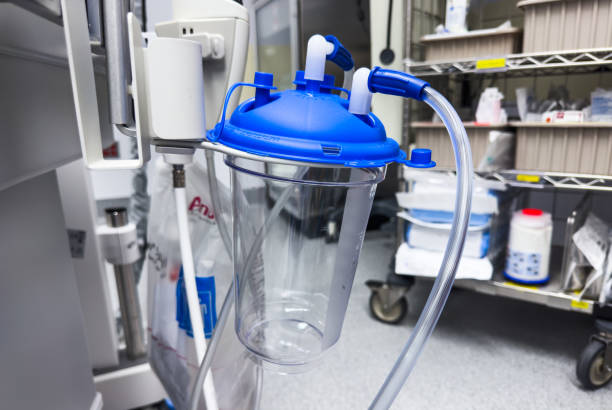
During suction, the system may come into contact with secretions and other potentially contaminating materials.
Filter design and accessory reprocessing procedures are therefore important evaluation considerations.
Role of Protective Filters
Depending on the model, a filter may help prevent contaminants from entering the vacuum source.
Some filters are designed to:
- Limit the passage of microorganism-carrying aerosols.
- Restrict liquid passage.
- Protect technical components.
- Reduce the risk of system contamination.
Filter performance should be confirmed using manufacturer documentation.
Not every filter should be assumed to provide equivalent performance or functions.
Wet or Blocked Filters
Some hydrophobic filters may reduce or prevent airflow when exposed to liquid as part of their protective mechanism.
This can reduce or interrupt suction.
If abnormal operation occurs, facilities should follow manufacturer instructions for inspecting and replacing accessories.
Cleaning and Disinfection
Components requiring management may include:
- Collection canisters.
- Canister lids.
- Suction tubing.
- Connectors.
- Equipment housings.
- Handles.
- Approved reusable accessories.
The appropriate reprocessing method depends on material, level of contact, and manufacturer instructions.
The same chemical or sterilization method should not be used for every accessory.
For example, some components are approved for repeated reprocessing, while certain filters or liners must be replaced according to manufacturer instructions.
Management of Collected Fluid Waste
Collected fluids should be handled according to the facility's infection-control and healthcare-waste management procedures.
In Vietnam, Circular No. 20/2021/TT-BYT regulates healthcare waste management within healthcare facilities.
When developing procedures, hospitals should classify and manage waste according to its characteristics, associated risks, and applicable regulations rather than assuming that all collected fluids require the same disposal method.
8. Power Supply, Batteries, and Mobility of Suction Equipment
For electrically powered suction equipment, the energy supply directly affects operational readiness.
Mains-Powered Devices
Evaluation factors include:
- Voltage.
- Frequency.
- Power consumption.
- Grounding requirements.
- Electrical protection.
- Continuous-operation conditions specified by the manufacturer.
A mains-powered device should not automatically be assumed to operate continuously without time limits.
Its operating capability must be consistent with the duty cycle stated by the manufacturer.
Devices with Backup Batteries
A battery can allow the device to continue operating within its specified capability when mains power is unavailable.
When evaluating the battery, consider:
- Battery technology.
- Capacity.
- Operating time.
- Charging time.
- Battery-level display.
- Low-battery warning.
- Battery replacement options.
- Service life and storage conditions.
In particular, battery runtime stated under test conditions does not automatically reflect actual runtime at every suction level.
Trolley-Mounted Suction Equipment
Some surgical suction units include an integrated trolley or mobile frame.
Factors to consider include:
- Dimensions.
- Weight.
- Push-handle design.
- Wheels.
- Wheel locks.
- Stability during movement.
- Collection-canister positioning.
- Ease of cleaning.
Suction Equipment Used in Ambulances
For transport environments, additional evaluation should cover secure mounting, vibration resistance, and operation under the environmental conditions stated by the manufacturer.
A device with a carrying handle should not automatically be considered suitable for permanent installation in an ambulance.
9. Performance Testing and Maintenance of Medical Suction Equipment
Medical suction equipment should be managed through an appropriate inspection and maintenance program to maintain operational readiness.
Testing Vacuum Generation
One important test is to verify the ability to generate and maintain a vacuum according to the method specified by the manufacturer.
Results should be compared with the device's technical limits.
Testing Suction Flow Rate
In addition to vacuum level, flow rate should be evaluated under appropriate measurement conditions.
These two parameters provide different information about system performance.
Confirming maximum vacuum alone does not therefore fully establish the system's operational capability.
Checking for Leaks
Locations that may affect airtightness include:
- Collection-canister lids.
- Seals and gaskets.
- Tubing.
- Connectors.
- Accessory connection points.
Leaks can reduce vacuum generation or affect stability during use.
Testing Overflow Protection
Overflow protection should be evaluated using an appropriate test method.
Relevant components may include:
- Float valves.
- Filters.
- Air pathways.
- Other protective mechanisms.
Testing should not be performed by deliberately allowing actual collected waste fluids to enter the system.
Battery Inspection
For battery-powered suction devices, facilities should monitor:
- Charging status.
- Operating capability.
- Low-battery warnings.
- Battery condition.
- Periodic inspection requirements.
For equipment prepared for emergency use, the management program should ensure that the device remains ready for use in accordance with established procedures.
Maintenance and Accessory Replacement
Components that may require maintenance or replacement include:
- Pumps.
- Motors.
- Valves.
- Suction tubing.
- Gaskets.
- Collection canisters.
- Filters.
- Batteries.
- Chargers.
- Vacuum gauges.
Maintenance frequency and scope should be based on manufacturer documentation and the facility's medical equipment management program.
After major repairs, equipment performance should be tested before the device is returned to service.
10. Technical Standards Relevant to Medical Suction Equipment
When selecting equipment, hospitals may refer to the ISO 10079 series, Medical Suction Equipment.
This series of international standards specifies requirements for medical suction equipment.
| Standard | Scope |
|---|---|
| ISO 10079-1:2022 | Electrically powered suction equipment |
| ISO 10079-2:2022 | Manually powered suction equipment |
| ISO 10079-3:2022 | Suction equipment powered by a vacuum or positive-pressure gas source |
| ISO 10079-4:2021 | General requirements for medical suction equipment |
ISO 10079-1:2022
This standard specifies safety and performance requirements for electrically powered medical and surgical suction equipment.
Its scope includes equipment used in healthcare facilities, home healthcare, and appropriate transport environments.
An amendment, ISO 10079-1:2022/Amd 1:2026, addresses protection against water ingress.
When evaluating technical documentation, facilities should check which edition and amendments have been used to assess the specific model.
ISO 10079-2:2022
This standard applies to hand-operated or foot-operated suction equipment designed for oropharyngeal suction within its stated scope.
Compliance with this standard should not be taken as evidence that a manual suction device is suitable for every surgical or patient-care application.
ISO 10079-3:2022
This standard applies to suction equipment powered by a vacuum or positive-pressure gas source.
This category may include devices connected to a medical gas pipeline system or another compatible gas supply.
ISO 10079-4:2021
This standard establishes general requirements used within the ISO 10079 series.
It is important to note that its scope excludes certain specialized equipment categories, including:
- Dental suction equipment.
- Anaesthetic gas scavenging systems.
- Blood salvage systems.
- Surgical smoke evacuation systems.
- Certain specialized endoscopic suction systems.
When evaluating equipment, healthcare facilities must establish whether a product falls within the ISO 10079 scope or requires reference to another standard.
Requirements Applicable in Vietnam
In addition to international technical standards, hospitals should review regulatory documentation, market authorization status, and the requirements for medical device management currently applicable in Vietnam.
A manufacturer's declaration of conformity with an ISO standard does not automatically replace legal requirements governing the distribution, procurement, or use of medical devices.
11. Operating Costs and Consumables
Alongside the equipment purchase price, facilities should evaluate costs over several years of use.
Potential expenses include:
- Replacement collection canisters.
- Disposable collection liners.
- Suction tubing.
- Protective filters.
- Seals and connectors.
- Replacement batteries.
- Pump spare parts.
- Maintenance services.
- Performance testing.
- Other consumables depending on the configuration.
Reusable Canisters Versus Disposable Liners
These two options have different cost structures.
Reusable canisters may reduce the need for frequent canister purchases, but facilities must account for cleaning, disinfection, labor, and replacement when damaged.
Disposable liners may simplify waste management, but their costs increase with each use.
Facilities should assess total costs under actual operating conditions.
Filter Costs
Filters may need replacement according to a schedule, usage conditions, or the occurrence of an unsuitable condition.
When specialized filters are used, confirm:
- Consumable price.
- Storage conditions.
- Shelf life.
- Supply availability.
- Equipment compatibility.
A different filter type should not be substituted without the manufacturer's confirmation of compatibility.
Pump Repair Costs
The vacuum pump is a key component of electrically powered suction equipment.
During procurement, hospitals should clarify:
- Warranty period.
- Pump-replacement policy.
- Spare-parts availability.
- Fault-response time.
- Repair costs.
- Maintenance conditions.
A device with a low purchase price but poor availability of compatible spare parts or filters may have higher long-term ownership costs.
12. Ten Criteria for Selecting Medical Suction Equipment for Healthcare Facilities
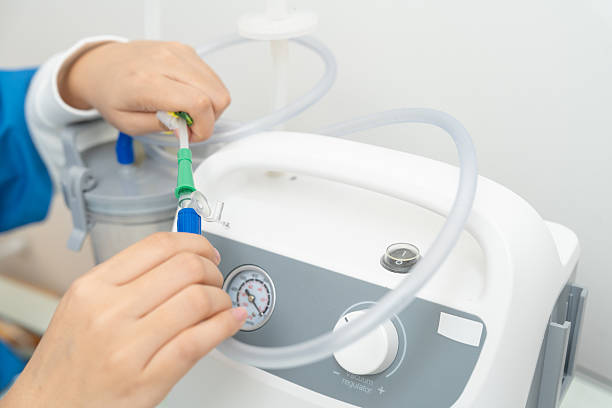
Hospitals and clinics may use the following criteria when comparing equipment models:
| Criterion | What Should Be Evaluated? |
|---|---|
| 1. Intended use | Surgery, emergency care, intensive care, transport, or other patient-care applications within the stated intended use |
| 2. Suction source | Electric pump, battery, manual mechanism, or central vacuum supply |
| 3. Negative pressure | Adjustment range, maximum level, and stability |
| 4. Suction flow rate | Flow under specified test conditions and performance under load |
| 5. Collection canisters | Capacity, number, material, and replaceability |
| 6. Protective systems | Overflow protection, filters, and relevant alarms |
| 7. Power and mobility | Batteries, charging time, weight, and transport accessories |
| 8. Infection control | Cleanability, disinfection, and single-use consumables |
| 9. Technical service | Training, warranty, spare parts, and maintenance in Vietnam |
| 10. Lifecycle cost | Purchase price, consumables, batteries, maintenance, and repairs |
Common Mistakes When Selecting Suction Equipment
Comparing only maximum vacuum: Failing to evaluate flow rate or stability when the device is used with accessories.
Choosing the most powerful device: Failing to verify adjustment capability and the manufacturer's stated intended use.
Overlooking overflow protection: Increasing the risk of fluids entering components not designed for liquid contact.
Failing to verify collection-canister supply: Making it difficult to replace canisters or liners when needed.
Failing to evaluate battery runtime: Procuring a device for transport that cannot meet the expected operating requirements.
Confusing a suction device with a central suction supply: Failing to confirm whether the device includes a pump or requires connection to the hospital vacuum network.
Excluding consumables: Resulting in higher operating expenses than budgeted.
Failing to assess maintenance support: Making it difficult to keep the device operational when technical faults occur.
13. Questions to Ask Medical Suction Equipment Suppliers
Before purchasing a device, hospitals and clinics should clarify:
- Which intended uses has the manufacturer approved or specified for the device?
- Does the device have an integrated vacuum pump, or does it require an external suction source?
- Under which test conditions are the negative-pressure range and flow rate determined?
- How effectively does the device maintain suction with the accessories used in practice?
- What is the collection-canister capacity, and does the system use reusable containers or disposable liners?
- What overflow-protection mechanisms and protective filters are included?
- If battery-powered, what operating time and charging conditions are specified?
- Which components require cleaning, disinfection, or replacement?
- Does the supplier provide performance testing, maintenance, and spare parts in Vietnam?
- How are total multi-year costs, including consumables, batteries, and maintenance, calculated?
Hospitals should ask suppliers to demonstrate performance using the exact collection-canister configuration, suction tubing, filters, and power source intended for use.
In particular, overflow protection, adjustment capability, and alarm functions should be tested under conditions consistent with manufacturer instructions.
Frequently Asked Questions About Medical Suction Equipment
What Is Medical Suction Equipment?
Medical suction equipment generates or uses negative pressure to help aspirate and collect fluids, secretions, or blood during appropriate patient-care and treatment activities.
How Does Surgical Suction Equipment Differ from General Suction Devices?
Surgical suction equipment is designed to meet the requirements of surgical use and may feature larger collection canisters, dedicated controls, and operating capabilities appropriate for the operating-room environment. However, the specific configuration depends on the model.
Does an Electric Suction Device Need a Battery?
Not every device includes a battery. Some models operate only on mains electricity, while portable or emergency suction units may have integrated batteries to support use when direct electrical power is unavailable.
Are Negative Pressure and Suction Flow Rate the Same?
No. Negative pressure describes a pressure differential, whereas suction flow rate describes the volume of gas or fluid moving per unit of time. Both parameters should be evaluated when selecting equipment.
Does Medical Suction Equipment Require a Filter?
Depending on the design, a device may use a protective filter to help prevent contaminants from entering the vacuum source. Facilities should use the filter specified in the manufacturer's instructions.
Can Suction Equipment Use Disposable Collection Canisters?
Some systems support disposable fluid collection liners. However, the liners must be compatible with the supporting canister or system specified for each model.
Can Medical Suction Equipment Connect to a Central Medical Vacuum System?
Devices designed to use an external vacuum source may connect to the hospital's central vacuum network through compatible regulators and accessories. An electrically powered suction unit should not be modified into a central vacuum device unless the manufacturer permits it.
Does Medical Suction Equipment Require Periodic Maintenance?
Yes. Medical suction equipment requires an appropriate inspection and maintenance program covering suction performance, airtightness, filters, overflow protection, power supply, and related components.
Explore Medical Suction Equipment and Surgical and Critical Care Solutions at Pharmedi Vietnam 2027
For hospitals and healthcare facilities, selecting medical suction equipment should be based on intended use, negative-pressure capability, suction flow rate, overflow protection, and infection-control requirements.
In addition to equipment performance, a reliable supply of collection canisters, suction tubing, filters, and maintenance services affects continuity of use.
Pharmedi Vietnam 2027, taking place from September 28–30, 2027 at the Saigon Exhibition and Convention Center (SECC), Ho Chi Minh City, provides an opportunity for businesses, specialists, and healthcare organizations to meet, learn about technologies, and discuss equipment solutions supporting medical care.
For healthcare facilities planning to equip or upgrade operating rooms, emergency departments, and intensive care units, the event offers an opportunity to explore technology trends, assess supplier capabilities, and prepare evaluation criteria before investment.
Relevant solution categories include electrically powered suction equipment, surgical suction devices, collection-canister systems, vacuum regulators, disposable accessories, and medical equipment management solutions.
When exploring solutions with suppliers, hospitals may focus on:
- Which clinical applications and operating environments is the device suitable for?
- Do the negative-pressure adjustment range and suction flow rate meet the intended requirements?
- What overflow-protection and vacuum-source protection functions are included?
- Are collection canisters, suction tubing, and filters easy to replace and reliably available in Vietnam?
- What are the device's power, battery, and mobility requirements?
- Does the supplier provide training, technical inspection, and periodic maintenance?
- How are total investment and long-term operating costs determined?
Preparing these criteria helps healthcare facilities proactively compare solutions, select equipment suited to their operating conditions, and minimize unexpected costs after commissioning.
For medical suction equipment, an appropriate solution should prioritize stable suction performance, reliable protective mechanisms, ease of cleaning, and long-term operational support rather than selection based solely on maximum vacuum or the initial purchase price.
Dates: September 28–30, 2027
Venue: Saigon Exhibition and Convention Center (SECC), Ho Chi Minh City
Exhibition Information: https://pharmed.vn/
Product Categories: https://pharmed.vn/exhibitors/products
Information about participating companies and event activities will be updated according to official announcements from the Pharmedi Vietnam 2027 Organizing Committee.
This article provides reference information on the operating principles, components, and selection criteria for medical suction equipment. It does not provide instructions for performing suction procedures on patients or setting suction pressures for specific clinical situations. Equipment selection, operation, and inspection should be performed by appropriately qualified personnel in accordance with manufacturer instructions, facility procedures, and applicable regulations.
Related post
- Vietnam launches Responsible Health AI Network (V-RHAIN): A strategic breakthrough in healthcare
- Tin ngành - Bản tin ngành Dược phẩm và Trang thiết bị y tế
- Tiny Robots Could Swim Through Your Blood to Prevent Strokes
- Pharmedi Vietnam 2019: Exhibitor's List ( Updating )
- Một số dự án mời gọi thầu cung cấp vật tư, thiết bị y tế (cập nhật ngày 05,06/06 /2019)